
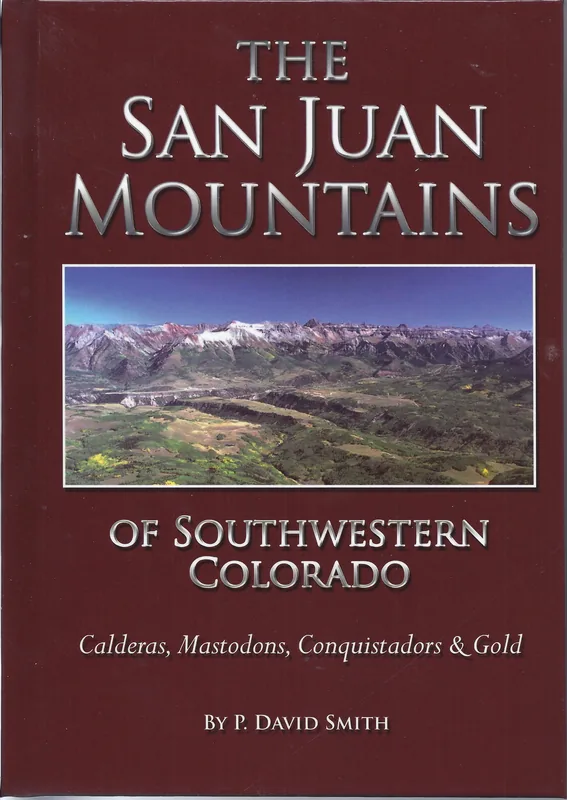
The San Juan Mountains of Southwestern Colorado - Calderas, Mastodons, Conquistadors, and Gold
Concentrating on unique events, people whose stories have never fully been told, and a few “new” facts, The San Juan Mountains of Southwestern Colorado - Calderas, Mastodons, Conquistadors, and Gold provides a wealth of information, starting with the true boundaries of Colorado’s San Juans. Through extensive research, P. David Smith destroys many long standing theories about this mysterious range, showing that Paleo hunters lived in the San Juans year round and the Spanish prospected almost continuously in the area but had little luck smelting the gold and silver ores. Smith shows how the Utes went from one of the poorest Native American tribes to one of the richest and points out that the Pueblo Indians (Anasazi) were the first of the historic tribes in Colorado and the San Juans. He also notes that Coronado or his men may well have been in the San Juans, rightfully looking for “Cibolla” amidst what has proven to be extremely mineral-rich terrain. Detailing the beginnings of the historically rich San Juans of Colorado, this work is one that both historians and history-lovers have awaited. It is true history that may be stranger than fiction.
- Published
- 2013
- ISBN
- 9781937851064
- Pages
- 450
- Place
- The San Juans
- Publisher
- Western Reflections Publishing Company
- Listed at
- $43.11
Publication details from Open Library. The price shown is the last one on record and is historic, not a current offer.
- Direct from us info@westernreflectionspublishing.com or (336) 565-6915. We pack and post from Lake City.
- Amazon Buy from Amazon.
- Any bookshop Quote ISBN 9781937851064 and your local bookseller can order it.
About this book
This large volume sets out to tell the beginnings of the San Juan Mountains of southwestern Colorado, from the geology to the gold. Its subtitle lists the cast: calderas, mastodons, conquistadors and gold. P. David Smith concentrates on unique events, on people whose stories have never fully been told, and on a few new facts.
The description says Smith starts with the true boundaries of the San Juans and then challenges long standing theories about the range. His research, it says, shows that Paleo hunters lived in the San Juans year round and that the Spanish prospected almost continuously but had little luck smelting the gold and silver ores. He also traces how the Utes went from one of the poorest Native American tribes to one of the richest.
Other claims in the description are more speculative and are presented as noted possibilities: that the Pueblo Indians, or Anasazi, were the first of the historic tribes in Colorado and the San Juans, and that Coronado or his men may have been in the San Juans looking for Cibola. Our catalogue lists the book at 450 pages and dates it 2013. The description ends by calling it true history that may be stranger than fiction, and says historians and history lovers have been waiting for it.
What is inside
The true boundaries
The book begins by defining where the San Juans actually are.
Paleo hunters
Smith argues that Paleo hunters lived in the range year round.
Spanish prospectors
The Spanish prospected almost continuously but struggled to smelt the ores.
The Utes' rise
It shows how the Utes went from one of the poorest tribes to one of the richest.
Pueblo peoples and Coronado
The Pueblo Indians' place in Colorado and the possibility that Coronado's men reached the range are covered.
Who it is for
This is a book for serious readers of Southwest and Colorado history who want the early chapters, long before the mining camps. Researchers, teachers and archaeology enthusiasts will find a wide range of topics gathered in one place. Libraries with strong regional shelves should look at it too. At 450 pages in our catalogue it is a substantial purchase and a real commitment, so it suits readers who like to settle in with one subject for a long while.
About the author
P. David Smith wrote this book, the largest of his books on our catalogue, and the description credits it to extensive research. No academic post or degree is listed for him in the sources we could reach, so we make no claims about that. Find the rest of his books on his author page.
The place and the period
The San Juans are a volcanic range. Wikipedia says they sit in the San Juan volcanic field, where the eruption of the La Garita Caldera, about 35 miles across, destroyed the volcanoes that once stood there. The area is highly mineralized and belongs to the Colorado Mineral Belt.
The range is high. Uncompahgre Peak, at 14,321 feet, is the tallest point, with Mount Wilson, Mount Sneffels and Mount Eolus also above 14,000 feet. The Weminuche Wilderness, the largest in Colorado, covers 499,771 acres, and the Continental Divide Trail follows the crest.
Wikipedia dates the modern mining story to 1869, when prospectors trespassing on the Ute reservation discovered silver. The Brunot Agreement, ratified by Congress on April 24, 1874, forced the Utes to cede all of the San Juan Mountains. Before that, it notes, the Utes had occupied all of western Colorado before 1848. The Sunnyside Mine near Silverton ran until late in the twentieth century, and the Idarado Mine closed in the 1970s.
Source: Wikipedia, San Juan Mountains
Good to know
What does the book cover?
Is it a mining guide?
How long is it?
When was it published?


Have a book of your own?
This is the kind of book the house publishes: regional history, biography, memoir and the stories that belong to a place. Send us yours and a person will read it.