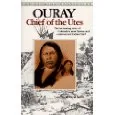
Ouray, Chief of the Utes
Many western history enthusiasts consider Ouray to be one of the greatest of all Indian chiefs. Unlike his contemporaries, he is remembered for his negotiating and peacekeeping skills, rather than for heroic deeds on the battlefield. He was a man of keen perception and a talented diplomat; but perhaps no other Indian chief was as enigmatic. He was extremely friendly with the whites, but also realized his people would be destroyed if they did not submit to white ways. A hero, a traitor, or just an ordinary person trapped by the course of events? P. David Smith presents the facts, allowing readers to draw their own conclusions.
- Published
- 1986
- ISBN
- 978-0-9608764-4-0
- Pages
- 222
- Category
- History
- Place
- Ouray
- Publisher
- Wayfinder Press
- Listed at
- $17.95
Publication details from Open Library. The price shown is the last one on record and is historic, not a current offer.
- Direct from us info@westernreflectionspublishing.com or (336) 565-6915. We pack and post from Lake City.
- Amazon Buy from Amazon.
- Any bookshop Quote ISBN 978-0-9608764-4-0 and your local bookseller can order it.
About this book
Ouray, Chief of the Utes is a biography of the Ute leader whom many western history enthusiasts count among the greatest of all Indian chiefs. According to the description, he is remembered for negotiating and keeping the peace rather than for heroic deeds on a battlefield, which sets him apart from many of his contemporaries.
The book takes on the contradictions. Ouray was extremely friendly with white settlers, yet he understood that his people would be destroyed if they didn't submit to white ways. The description asks the obvious question: was he a hero, a traitor, or an ordinary person trapped by the course of events? Nobody is told what to think here.
P. David Smith presents the facts and lets readers draw their own conclusions. Our catalogue lists this as a 1986 book from Wayfinder Press, 222 pages, with Ute Indians, Biography, History and Indians of North America among its subjects. Later in his career Smith returned to Ouray's world with a book about Ouray's wife, Chipeta, which is also in our catalogue.
What is inside
A peacekeeper, not a warrior
The book explains why Ouray is remembered for diplomacy and peacekeeping rather than battlefield heroics.
Friendly with the whites
It examines his friendly relations with white settlers and officials.
A people under pressure
Ouray believed the Utes would be destroyed if they did not submit to white ways.
Hero or traitor
The author sets out the facts and leaves the verdict to the reader.
Biography and bibliography
The catalogue subjects include Biography, Ute Indians and Indians of North America.
Who it is for
Readers of Colorado and Ute history will find this a direct way into the life of one of the state's best-known Native leaders. It is suited to students writing about the Ute removal, to visitors to Ouray and the Uncompahgre Valley who want to know the man behind the town's name, and to anyone interested in how diplomacy worked on the American frontier. Readers looking for a one-sided portrait should look elsewhere, because this book deliberately declines to supply one.
About the author
P. David Smith wrote this biography, which our catalogue dates to 1986, the earliest of his books in our catalogue. We found no biography to draw on, so this note sticks to the book. His author page shows where this one sits among the rest.
The place and the period
Wikipedia gives Ouray's years as about 1833 to 1880. He was a Tabeguache, or Uncompahgre, Ute leader, raised near Taos, and he learned Ute, Apache, sign language, Spanish and English. He became band chief in 1860 and favored treaties over armed resistance, which led some Utes to call him a coward.
His signature runs through the treaties that reshaped Colorado. The 1863 Treaty of Conejos roughly halved Ute lands, and Ouray translated at the negotiations. The treaty of 1868 created a reservation in western Colorado. The Brunot Agreement opened mineral-rich land in the San Juans, and Congress ratified it on April 24, 1874.
After the killing of agent Nathan Meeker and others in 1879, Ouray asked the warriors to release their hostages, who were brought to his home and cared for by his wife Chipeta. He died in August 1880 of Bright's disease, soon after negotiating the treaty that led to the removal of the White River and Tabeguache Utes to Utah. His remains were reburied at Ignacio, Colorado, in 1925.
Source: Wikipedia, Ouray (Ute leader)
Good to know
Who was Ouray?
Does the book take a side on whether he was a hero or a traitor?
Is it fiction?
Is there a companion book about his wife?


Have a book of your own?
This is the kind of book the house publishes: regional history, biography, memoir and the stories that belong to a place. Send us yours and a person will read it.