
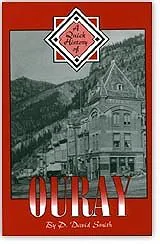
A Quick History of Ouray
The history of "Ouray - Gem of the Rockies" is a fascinating tale of the typical boom and bust cycles of all of Colorado's major mining towns. Silver brought the first prospectors to the beautiful valley, but gold kept Ouray from becoming a ghost town after the Silver Crash of 1893. The town rebounded due to demand for metal prices during World War I and II but it slipped into an economic depression after each war. Although tourism was always important, in the 1970s it became more vital to the economy, and the town has continued to grow and prosper since that time. The abandoned ghost towns and mining relics that litter the local hillsides can be seen by anyone traveling the jeep trails interlacing the local mountains, which contain some of the most amazing scenery in the world.
- Published
- 1999
- ISBN
- 978-1-890437-11-4
- Pages
- 96
- Category
- History
- Place
- Ouray
- Publisher
- Western Reflections Publishing Co.
- Listed at
- $15.05
Publication details from Open Library. The price shown is the last one on record and is historic, not a current offer.
- Direct from us info@westernreflectionspublishing.com or (336) 565-6915. We pack and post from Lake City.
- Amazon Buy from Amazon.
- Any bookshop Quote ISBN 978-1-890437-11-4 and your local bookseller can order it.
About this book
A Quick History of Ouray tells the story of Ouray, Colorado, the town the catalogue calls "Gem of the Rockies." P. David Smith presents it as a typical Colorado mining town, one that rose and fell and rose again. Silver brought the first prospectors to the valley, and the rest of the book follows what happened next.
The description hangs on a turning point. After the Silver Crash of 1893, it was gold that kept Ouray from becoming a ghost town. Demand for metals during World War I and World War II lifted the town again, and each time it slid into an economic depression once the war ended. Tourism had always counted for something, but in the 1970s it became vital to the local economy, and the town has kept growing since.
The book also looks outward from Main Street. The abandoned ghost towns and mining relics on the surrounding hillsides can be reached by anyone willing to drive the jeep trails that cross the local mountains, and the description rates that scenery among the most amazing anywhere. Our catalogue lists the book at 96 pages, so it is meant to be read in an evening or two and then carried in the glove box on your next drive through the San Juans.
What is inside
Silver and the first prospectors
Silver brought the earliest prospectors into the valley that became Ouray.
The Silver Crash of 1893
Gold, not silver, kept the town from turning into a ghost town after the crash.
Two wars, two slumps
Metal prices rose during both world wars, and the town fell into depression after each.
Tourism takes the lead
From the 1970s tourism grew more vital to the economy, and the town has prospered since.
Ghost towns on the jeep trails
Abandoned towns and mining relics can still be seen along the local jeep roads.
Who it is for
This short history suits visitors who want to know what they are looking at when they walk Ouray's streets or drive its mountain roads. It is a good first book for newcomers and seasonal residents, and for teachers who need a compact account of one Colorado mining town. Readers who already own the longer San Juan histories may like it as a quick refresher on the boom and bust pattern. It does not try to be exhaustive, and it doesn't pretend to be.
About the author
P. David Smith is the author of this book and of seven other books in our catalogue that deal with Ouray, the Utes and the San Juan Mountains. Nothing we could verify tells us where he lives or what else he has done. The other seven are on his author page.
The place and the period
Ouray sits in a steep valley in the San Juan Mountains. Wikipedia's account says prospectors arrived in 1875 and the town was incorporated on October 2, 1876, named for Chief Ouray of the Utes. In 1877 it became the county seat of the new Ouray County and its population passed 1,000.
Gold shaped the town's fortunes. In 1877 William Weston and George Barber found the Gertrude and Una veins in Imogene Basin, and Thomas Walsh acquired them. Walsh went on to develop the Camp Bird Mine, which the article dates to 1896 or 1897. By 1902 it had yielded about 200,000 ounces of gold, when Walsh sold it to Camp Bird, Ltd.
The Denver & Rio Grande Railway reached Ouray on December 21, 1887, and the last regularly scheduled passenger train ran on September 14, 1930. Today Main Street is a National Historic District of mostly late 19th century buildings, and tourism, including the Ouray Ice Park and the hot springs, anchors the economy.
Source: Wikipedia, Ouray, Colorado
Good to know
What is the main idea of the book?
Is it a long read?
Does it cover the modern town?
Can I visit the places it describes?


Have a book of your own?
This is the kind of book the house publishes: regional history, biography, memoir and the stories that belong to a place. Send us yours and a person will read it.