
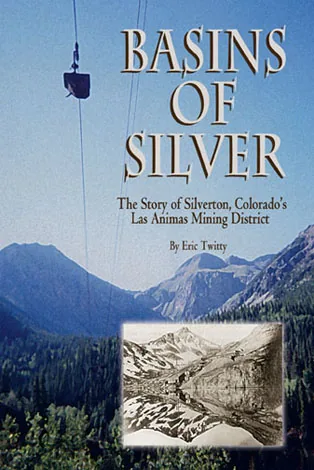
Basins of Silver-Hardbound
by Eric Twitty
The story of the Las Animas Mining District began with the Colorado Gold Rush of 1860, but it was silver that kept the local mines operating for over one hundred years. The region laid claim to many mining firsts in Colorado and the San Juan Mountains, and served as the cradle for engineering and mining practices that revolutionized the entire mining industry. The area was the scene of the first two mineral rushes to the San Juan Mountains, which included the first hard rock mine and ore treatment mill. The first and the longest aerial tramways were built here, which helped to further the inaugural practices of mining low grade ore. One of the first and most advanced mining power grids and power plants were used in the district. These practices ultimately helped save the Colorado mining industry when the bottom fell out of the price of silver.
- Published
- 2008
- ISBN
- 9781932738445
- Pages
- 392
- Category
- History
- Place
- The San Juans
- Publisher
- Western Reflections Pub.
- Listed at
- $32.32
Publication details from Open Library. The price shown is the last one on record and is historic, not a current offer.
- Direct from us info@westernreflectionspublishing.com or (336) 565-6915. We pack and post from Lake City.
- Amazon Buy from Amazon.
- Any bookshop Quote ISBN 9781932738445 and your local bookseller can order it.
About this book
Basins of Silver is the history of the Las Animas Mining District, the mining country around Silverton in Colorado's San Juan Mountains. The story begins with the Colorado Gold Rush of 1860. It was silver, though, that kept the district's mines working for over one hundred years.
Eric Twitty makes a big claim for this one corner of the state, and the book sets out to back it up. The district saw the first two mineral rushes to the San Juan Mountains, along with the first hard rock mine and ore treatment mill there. It also built the first and the longest aerial tramways, which helped begin the practice of mining low grade ore.
There is a power story too. One of the first and most advanced mining power grids and power plants ran in the district. According to the description, those practices helped save the Colorado mining industry when the bottom fell out of the price of silver. This is a hardbound edition, and the Open Library record shows bibliographical references and an index, so you can follow the research behind the telling.
What is inside
The 1860 beginnings
The district's story began with the Colorado Gold Rush of 1860.
First rushes and first mines
The district saw the first two mineral rushes to the San Juans, including the first hard rock mine and ore treatment mill.
Aerial tramways
The first and the longest aerial tramways were built here, and they helped make low grade ore worth mining.
Power for the mines
One of the first and most advanced mining power grids and power plants served the district.
Silver's long run
Silver kept local mines operating for over one hundred years, even as prices collapsed.
Notes and index
The edition includes bibliographical references and an index for readers who want to dig further.
Who it is for
Basins of Silver is for readers of Colorado mining history, San Juan Mountains travelers who have driven the roads out of Silverton, and anyone who wants to understand how the technology of mining changed. Engineers, hobby prospectors and local historians will find the tramway and power details useful. Libraries with Western history shelves will want it for the references and index. It is a long, serious history, not a quick pamphlet, and it assumes you are curious enough to stay with one district for a few hundred pages.
About the author
Eric Twitty has written about mining history for Western Reflections. Open Library lists three of his books, two of them published in 2001 and 2002 and this one in 2008. All three are in our catalogue and all concern mines and mining. We don't have a longer biography to offer, so we won't make one up. His author page lists the other two.
The place and the period
The Las Animas Mining District covers the high basins around the upper Animas River near Silverton. A county road guide dates its active years from the mid-1870s into the early 1900s, with hundreds of mines, dozens of mills and four or five boom towns. History Colorado places Silverton at the center of the San Juan mining district and notes that the first profitable silver vein was found in nearby Arrastra Gulch in 1871.
Several of those towns have their own dates. Howardsville began as Bullion City in 1874 and was briefly the first county seat of La Plata County until Silverton took the title in 1875. Animas Forks saw its first log cabin in 1873 and had about 450 people by 1883. Eureka grew up around the Sunnyside mine.
Transportation and milling shaped the district too. Otto Mears built the narrow gauge Silverton Northern Railroad to serve the mines and mills, reaching Animas Forks and Howardsville in 1896. The Mayflower Mill began processing ore in February 1930 and operated until 1991, according to the same guide.
Good to know
What area does the book cover?
Is it fiction or nonfiction?
When was this edition published?
Is this the hardbound edition?
Where can I buy it?


Have a book of your own?
This is the kind of book the house publishes: regional history, biography, memoir and the stories that belong to a place. Send us yours and a person will read it.