
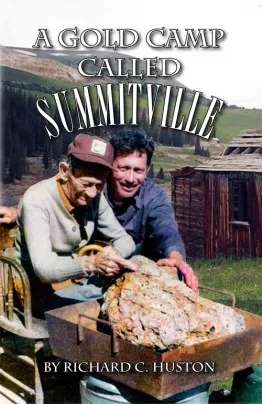
Gold Camp Called Summitville
In the spring of 1870, five Union Army veterans followed the South Fork of the Rio Grande River up to a stream that ran along the base of 13,000 foot South Mountain located in the "Alps of America." There, at a place they named Wightman Fork, the discovery of some promising gold nuggets led to more prospecting and the eventural formation of the Summit (Summitville) Mining District in the then Colorado Territory of the United States. From a brilliant beginning to an ignoble ending, Summitville thrived, survived, and ultimately died, still boasting a history of the richest ore deposits in Colorado's mineral-rich San Juan Mountains. In A Gold Camp Called Summitville, the area's geology, its mining bonanzas, and personal recollections and revelations are woven together to paint an accurate picture of the company town of Summitville and the demanding life above 11,000 feet elevation.
- Published
- 2012
- ISBN
- 978-1-937851-01-9
- Pages
- 190
- Category
- History
- Place
- The San Juans
- Publisher
- Western Reflections Publishing Company
- Listed at
- $19.37
Publication details from Open Library. The price shown is the last one on record and is historic, not a current offer.
- Direct from us info@westernreflectionspublishing.com or (336) 565-6915. We pack and post from Lake City.
- Amazon Buy from Amazon.
- Any bookshop Quote ISBN 978-1-937851-01-9 and your local bookseller can order it.
About this book
Gold Camp Called Summitville is Richard Huston's history of the Summit (Summitville) Mining District in the San Juan Mountains of Colorado. The description opens in the spring of 1870, when five Union Army veterans followed the South Fork of the Rio Grande River up to a stream at the base of 13,000 foot South Mountain. At a place they named Wightman Fork, promising gold nuggets led to more prospecting and to the district's formation in what was then Colorado Territory.
The book follows the camp from what the description calls a brilliant beginning to an ignoble ending. Summitville thrived, survived and ultimately died, while holding the history of the richest ore deposits in the San Juans.
Huston weaves together the area's geology, its mining bonanzas, and personal recollections to describe the company town and the demanding life above 11,000 feet. The catalogue lists 190 pages, and Open Library's subjects are gold mines and mining, frontier and pioneer life, and history.
What is inside
The 1870 discovery
Five Union Army veterans find gold nuggets at Wightman Fork below South Mountain.
The district forms
More prospecting leads to the Summit Mining District in Colorado Territory.
Geology and bonanzas
The area's geology and its richest ore deposits are part of the telling.
Company-town life
Recollections describe daily life above 11,000 feet.
Who it is for
This book is for readers of San Juan Mountains mining history and for anyone curious about a high company town. It suits those who like geology and personal recollection alongside dates and discoveries.
About the author
Richard Huston also wrote Silver Camp Called Creede, which our catalogue lists from 2005. We found no biography for him, so we describe him through his books. His author page lists both.
The place and the period
Summitville sits in Rio Grande County, Colorado, on South Mountain at roughly 11,500 feet, about 25 miles south of Del Norte, according to Wikipedia. The same article records that a modern open pit operation there ended in 1991, and that the site was listed as a Superfund site on May 31, 1994.
Source: Wikipedia, Summitville mine
Ways to use this book
Pairing the book with the museum's account
Local museums often hold photographs and recollections that complement a published history. Read the Rio Grande County Museum page first, then ask the museum about the camp's records before a visit to Del Norte.
Understanding the Superfund story
Readers curious about what happened after the camp closed can read the EPA site profile, which explains the cleanup and names contacts for community questions.
Heading up the mountain
The county tourism page covers the historic district as a place to visit. Confirm road and weather conditions locally first, since the camp sits at a high elevation.
Go deeper
Summitville stands above 11,000 feet in the San Juan Mountains, and its story runs from an 1870s gold rush to a modern cleanup. These pages cover both ends of that history.
Summitville at the Rio Grande County Museum
The museum's page on how the camp became a boomtown, with details on the Little Annie Mine, the mills and the town's decline in the 1880s and 1890s.
Rio Grande County Museum: Summitville → (opens in a new tab)
Summitville Historic Mine District
A county tourism page on the district's early gold discoveries, its post office history and the seasonal rhythm of mining at high elevation.
Summitville Mine Superfund Site
The EPA profile of the 1,400 acre site, covering the later open pit mining and the contamination of Wightman Fork and the Alamosa River.
Good to know
What period does the book cover?
Is it fiction?
Where is Summitville?
Where can I buy it?


Have a book of your own?
This is the kind of book the house publishes: regional history, biography, memoir and the stories that belong to a place. Send us yours and a person will read it.