
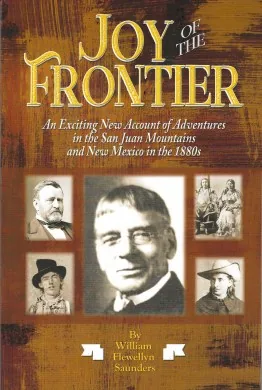
Joy of the Frontier
and the history it affects includes early Christian bible camps, The Civil War's effect on women and children, life in early Ouray, Colorado, details on the Uncompahgre Indian Agency, the relief effort to safely return the captured women of the Meeker Massacre, the personality of Billy the Kid, information on Wyatt Earp and Doc Holiday in their later years, and the "craziness" of early Santa Fe and Albuquerque. He also was close to Chief Ouray and Chipeta and relates their feelings of what was happening to the Utes before and after the Meeker Massacre.
- Published
- 2006
- Place
- Ouray
- Listed at
- $26.92
Publication details from Open Library. The price shown is the last one on record and is historic, not a current offer.
- Direct from us info@westernreflectionspublishing.com or (336) 565-6915. We pack and post from Lake City.
- Amazon Search Amazon for this book. Out of print books usually turn up through marketplace sellers.
About this book
Joy of the Frontier is an account of frontier life, and our record lists it with the place Ouray, Colorado. The catalogue description is a list of what the history around the author touches: early Christian bible camps, the effect of the Civil War on women and children, life in early Ouray, and the Uncompahgre Indian Agency.
It goes on to the relief effort to bring home safely the captured women of the Meeker Massacre. The same description mentions the personality of Billy the Kid, Wyatt Earp and Doc Holiday in their later years, and the craziness of early Santa Fe and Albuquerque. It says the writer was close to Chief Ouray and Chipeta and relates their feelings about what was happening to the Utes before and after the Meeker Massacre.
Wikipedia's article on Chipeta explains the Meeker events in outline. In September 1879 Utes killed 11 white men at the White River Agency and took three women and two children captive. After their release the captives were brought to the home of Chipeta and Ouray.
Who it is for
The record points to readers of Ouray and Western Slope history, and of the Ute story around the 1879 Meeker events. It is personal testimony as the description presents it, so it works as a source alongside the standard histories rather than in place of them.
Ways to use this book
Visiting Ute history in Montrose
The museum page describes the memorial park, trails and picnic areas around the building. Check its website for current hours before you go, then read the Ouray and Chipeta articles on the way.
Reading a memoir against the encyclopedia
Personal accounts and encyclopedia entries often differ in detail. Read the book, then the two biographical articles, and note where each handles the same events differently.
Planning a summer in the San Juans
Ouray's historical society posts a talk series each summer. Look it up when you plan the trip, and pair a talk with a visit to the museum.
Go deeper
The catalogue description ties this book to Ouray, Colorado, and to the Ute people of the area. These places and pages give context for the events it names.
Ute Indian Museum
A History Colorado museum, built in 1956 near the ranch of Chief Ouray and Chipeta, whose grounds hold Chipeta's grave. Its page says the museum works with the three Ute tribes.
Chipeta, Colorado Encyclopedia
A biographical article on Chipeta, the wife of Ute leader Ouray, covering her role on the Ute council and the Utes' removal from their homelands.
Ouray, Colorado Encyclopedia
An article about Chief Ouray, a Northern Ute leader who negotiated treaties and tried to avoid conflict.
Ouray County Historical Society
A local society and museum with archives for Ouray County; its site lists summer talks at the Wright Opera House.
Good to know
Where is the book set?
Does it cover the Meeker Massacre?
Is it fiction or nonfiction?
Who wrote it, and when was it published?


Have a book of your own?
This is the kind of book the house publishes: regional history, biography, memoir and the stories that belong to a place. Send us yours and a person will read it.