Professional Book Editing Services From an Independent Publisher
Every book that reads easily was edited hard. Readers never see that part, but authors don't forget it: the draft that felt finished, then came back with a structural problem you couldn't see, sentences that could be sharper, and small inconsistencies that would have followed the book forever.

Our book editing services cover every level, from big-picture developmental work to the last proofread. Western Reflections Publishing has been publishing books since 1996, and the editors who work on your manuscript are the same kind who edit ours. Tell us where your draft stands and we'll tell you honestly what it needs, and what that costs.
Why authors send us their manuscripts
- Publishing since 1996. An independent house in Lake City, Colorado, with a back catalogue of regional history, biography, memoir and Western writing.
- Your rights stay yours. Copyright, royalties and the manuscript remain with you. Nothing you sign takes ownership of your work.
- Fixed fees, published rates. Per-word prices are on our pricing page, and your quote is a fixed fee agreed before work starts.
- NDA signed before we begin. Your manuscript stays private from the first email.
Why a draft that feels finished usually isn't
You've read your own book so many times that your brain fills in what the page leaves out. A missing step in an argument feels fine because you know the step. A clumsy sentence feels fine because you know what you meant. That's not a flaw in your writing. It's how every writer's eye behaves after the fortieth read, and it's the reason publishers pay editors in the first place.
Editing isn't one task. It's four jobs that look at four different layers of a book, and each one catches things the others can't. A proofreader won't fix a saggy middle. A developmental editor won't hunt down a comma splice. Hiring the wrong kind of editor at the wrong moment is the most common way authors spend money and still end up with a book that has problems.
If you're publishing independently, the stakes are higher. A traditional house gives its authors an editorial safety net, and self-publishing doesn't. Readers still judge both books by the same standard. Poor reviews rarely say "this author can't write." They say "needs an editor." That one line has sunk plenty of strong ideas.
So the real question isn't whether to edit. It's which level your manuscript needs, in which order, and how to pay for exactly that and nothing extra.
It's which level your manuscript needs, in which order, and how to pay for exactly that and nothing extra.
The four levels of book editing
The four levels work best in a set order, because each one assumes the layer above it is settled. Polishing the sentences of a chapter that may get cut is wasted money.
This is the big-picture edit and the most involved. A developmental editor reads your book as a whole and asks whether the structure holds, whether the argument builds, whether the pacing works and whether anything is missing or doesn't belong. In fiction that means plot, character arcs and tension. In nonfiction it means the logic and order of your ideas. This is where a good manuscript becomes a strong book. Our developmental editing service handles this stage, and the starting rate is $0.034 a word.
Once the structure holds, a line editor works at the level of sentences and paragraphs: rhythm, clarity, tone and voice. Repetition goes. Awkward phrasing gets rebuilt. Flabby sentences get tightened until the writing sounds the way you meant it to. If you want one stage that changes how the book feels to read, this is it. See our line editing service, at $0.027 a word.
Copyediting is the technical correctness pass: grammar, punctuation, spelling and consistency, checked against a style guide. It catches the details that quietly weaken a book, like a character's eye color changing in chapter nine, a term hyphenated three different ways or dates that don't add up. Our copyediting service covers this level at $0.023 a word.
The proofread comes last, after the book has been formatted and typeset. It's the final check for typos that slipped through, awkward line breaks, spacing problems and any error the layout process introduced. It's also the one stage that can't be done early, because the pages have to exist first.
Our proofreading service is the lightest pass, at $0.016 a word. Skipping it is how obvious errors end up in print.
If you'd like a longer walkthrough with examples of each level, our guide to the types of book editing goes through them one by one.
Tell us about the project
Send a few details about book editing services and a person on our team will reply with a fixed quote. You'll know the price before any work begins.
Prefer to talk? Call (336) 565-6915, Monday to Friday, 9am to 5pm Mountain Time.
Which level of editing does your manuscript need?
It's the question we hear most, and the honest answer depends on where your book actually is today. Use the situations below as a rough map.
- A complete draft nobody has seen. Start with developmental editing. Structural problems are cheaper to fix before anyone polishes the prose.
- Structure is solid, but the writing feels flat. You need a line edit. This is the usual gap for authors who write well but haven't been edited professionally before.
- It reads well and you want it correct and consistent. That's a copyedit.
- It's edited, laid out and about to go to print. Get a proofread. Always.
- You're not sure. Send us a sample. We read it before we quote, and we'll say plainly if your manuscript needs an earlier stage than the one you asked for. Sometimes the answer is less than authors expect.
Many books benefit from more than one level, and our manuscript editing service combines the stages your book needs into a single process. You pay only for the stages the book needs. We don't sell packages.
One caution about self-editing. It's worth doing before you send anything out, because a cleaner draft gives an editor more to work with, and our guide on how to self-edit your book shows how. But it doesn't replace a second pair of eyes. Nobody can reliably edit a book they wrote.
What you get with every edit
The level changes. The way we work doesn't.
- An editor matched to your book. We pair you with someone who knows your genre or subject, so the feedback is informed rather than generic.
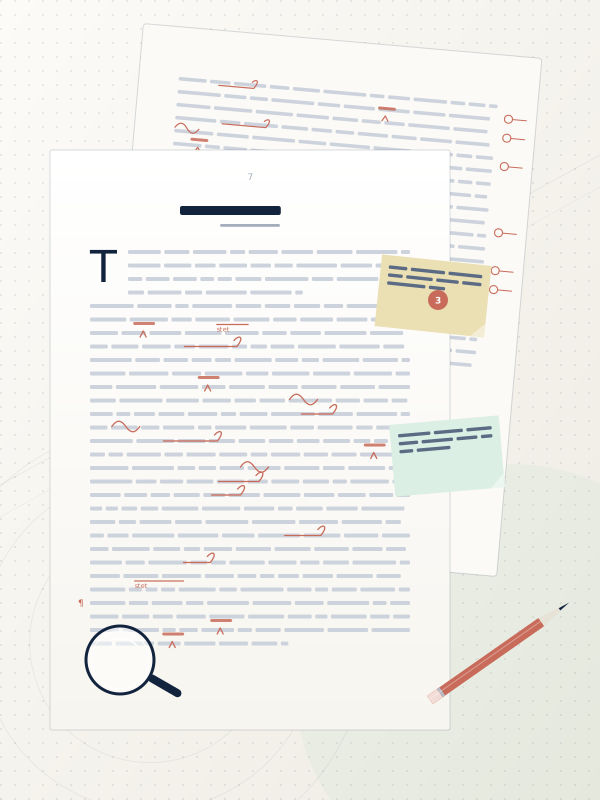
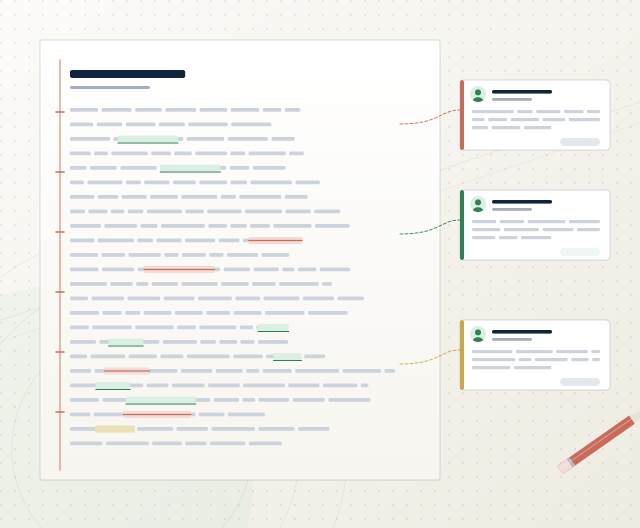
- Tracked changes and comments. You see every suggestion and control it. Accept, reject or discuss any change.
- Your voice, preserved. Good editing strengthens how you write. It doesn't overwrite it. We sharpen your prose and keep it recognizably yours.
- One team for the whole book. A writer, an editor and a project manager stay with the book from the first conversation to the final file.
- A clear next step. When the edit is done you get a polished manuscript ready for whatever comes next: another editing level, formatting or publication.
The edit comes with a scope agreed in writing before work starts, so you know what the editor will and won't touch. A line edit isn't a rewrite, and a copyedit isn't a restructure. When a manuscript needs something outside the scope you booked, your editor says so and you decide whether to add it.
The edit comes with a scope agreed in writing before work starts, so you know what the editor will and won't touch.
What editors actually find in a manuscript
Authors often imagine an edit as a hunt for typos. In practice the problems that matter most are bigger and quieter. Here's what turns up again and again, grouped by the level that fixes it.
- Structure (developmental). A first chapter that explains instead of pulling the reader in. A middle that sags because three scenes do the same job. A nonfiction argument that jumps from point two to point five. A memoir that hides its real subject until page 120.
- Sentences (line). The same opening word on six sentences in a row. Adverbs doing the work a stronger verb should do. A paragraph that says one thing three ways. Dialogue that explains what the reader already saw.
- Consistency (copy). A name spelled two ways. A character who's left-handed in chapter two and writing with her right hand in chapter eleven. Numbers written as words on one page and digits on the next. Headings that don't follow one pattern.
- Final errors (proof). A widow line stranded at the top of a page. A chapter title that doesn't match the table of contents. A missing space that appeared when the file was exported.
None of these is a sign you're a weak writer. They're what a draft looks like before another professional has read it. Seeing them named also helps you judge a quote: if the editor can't tell you what they'd look for at the level you're buying, that's worth a question.
Style guides, consistency and the choices editors make for you
Copyeditors work from a style guide, which is a rulebook that settles questions like serial commas, how numbers are written and when a term gets capitalized. For most American trade books the standard reference is The Chicago Manual of Style. Some genres and businesses use others, and a few authors have house rules of their own.
You don't need to memorize any of it. What you need is for your editor to pick a system, apply it everywhere and keep a short sheet of the decisions made, such as how your invented place names are spelled or whether you write "e-book" or "ebook". That sheet matters later. It keeps the proofreader, the formatter and any future edition consistent with the manuscript.
If you already have preferences, say so when you send the sample. If you don't, your editor will set them and explain the calls that affect your voice.
If you already have preferences, say so when you send the sample.
How to get the most from your edit
A little preparation makes any edit cheaper and better. Before you send the manuscript:
Editing a book that's still changing wastes money, because every rewrite erases some of the editor's work.
You'll hear the clumsy sentences your eyes skip.
Don't pay a professional rate to catch typos your software would flag.
Send a one-page summary of the audience, the promise of the book and any style choices you've made.
If a chapter troubles you, tell the editor. They'll read it more closely.
Work from a single version so tracked changes don't scatter across copies.
When the edited file comes back, give yourself a few days before you respond. A comment that stings on Monday often looks obviously right by Thursday. Work through the changes in order and answer the editor's questions in the margin, then send it back. If something isn't clear, ask. A good editor wants to explain, not defend.
Editing fiction, memoir and nonfiction: what changes
The four levels stay the same across genres, but what the editor looks for shifts a lot.
Fiction
A fiction editor reads for momentum. Does each scene change something? Does the reader know what the main character wants, and does the cost of failing it keep rising? Continuity matters here too: ages, timelines, geography, who knows which secret and when. These slip easily over a long manuscript, and readers notice every one.
Memoir
Memoir editing is partly about shape. Real life doesn't arrive in tidy arcs, so the editor helps you decide which events carry the story and which are merely true. A good memoir edit also protects your voice, since the book lives or dies on whether it sounds like you.
Nonfiction and business books
Here the editor reads as the skeptical customer. Is the promise on the cover kept by the last chapter? Are the examples doing real work, or are they there to pad? Does each chapter hand the reader something they can use? Nonfiction authors are often experts, which makes them the people least able to see what a newcomer would need explained.
Children's books and short works
Short manuscripts get a different kind of attention. When there are only a few hundred words, every one carries weight, so a line edit can matter more than a developmental pass. The per-word math is small, which is where the minimum fee applies. If you're working on one, tell us the genre and age range up front.
How our editing process works
Here's how a project runs from your first message to the finished manuscript.
Send us your book and tell us where you are with it, who it's for and what you think it needs. A few honest sentences are enough. If you're worried about the state of the draft, say so. Editors have seen worse.
We read a sample and tell you which level of editing your manuscript requires, then quote for exactly that. This is also where we'll say so if you've asked for a stage that wouldn't help yet. We'd rather lose a sale than sell you the wrong edit.
Your editor works through the manuscript at the agreed level, with tracked changes and comments in the file. Expect several weeks per stage, depending on length and complexity. We give you a realistic schedule when we quote, and if your deadline can't be met we'll tell you at that point, not three weeks in.
You go through the edits, accept what works, push back on what doesn't and ask questions. Then we deliver the finished manuscript. Your approval is the last word, because it's your book.
What book editing costs
Our rates are published, because a price you have to chase isn't much help when you're planning a budget. The numbers below come from our pricing page, where you can see every service we offer.
| Service | Rate |
|---|---|
| Manuscript assessment | $0.020 a word |
| Developmental edit | $0.034 a word |
| Line edit | $0.027 a word |
| Copy edit | $0.023 a word |
| Proofread | $0.016 a word |
Proofreading carries a minimum fee of $450 a pass, which mostly matters on short books. Editing, design and production are half on booking and half on delivery. We don't ask for a full project fee up front, and there's no hourly billing, so there are no surprise invoices.
Take a manuscript of 80,000 words. That's the sort of length that fills roughly 300 printed pages, though the exact page count depends on your trim size and layout.
- Proofread: about $1,280
- Copy edit: about $1,840
- Line edit: about $2,160
- Developmental edit: about $2,720
- Manuscript assessment: about $1,600
Run all four editing levels back to back and the total comes to about $8,000, which is why most books don't use all four. A clean, well-structured draft might need a line edit and a proofread. A first draft from a new author might need a developmental edit and a copyedit before the proof. That's why we read a sample first.
For perspective, our typical independent book, with editing, a cover, layout and print-ready files, lands between $2,500 and $6,000.
Three things change your number: length, which stages you need and what condition the manuscript is in. A longer book costs more at every level. A draft that needs heavy work takes an editor longer than a clean one, and we look at a sample before quoting so the figure fits the real manuscript rather than a guess. For books around 20,000 words, the per-word math can land under a minimum fee, in which case the minimum applies.
If you'd like to compare against the wider market, the Editorial Freelancers Association publishes median editing rates from its member survey, which is a fair yardstick for any quote you're weighing, ours included.
Why authors choose us for editing
We're a publisher, not just an editing shop
Western Reflections is an independent house based in the San Juan Mountains. We publish books, and our editorial board reads what comes in. That changes how we edit: we know what happens to a manuscript after the edit, in layout, in print and in the hands of readers.
Honest recommendations
We tell you what your manuscript needs, including when that's less than you expected. If the book isn't ready for the stage you asked for, we say so and explain what it needs instead. Some work we turn down, because we can't do it well.
Editors who know your genre
Genre matters more than most authors expect. A memoir editor listens for different things than a business-book editor does, and a fiction editor tracks continuity in ways a nonfiction editor never has to. We match on that.
Complete confidentiality
Your manuscript stays private. A non-disclosure agreement is signed before you send us a single page.
One team, start to finish
Editing can stand alone, or it can continue into book formatting, cover design and full publishing, all with the same team. You won't have to explain your book three times to three vendors.
Want to see what other authors say about working with us? The testimonials page has their words, not ours.
Who our book editing services are for
Independent authors
If you're publishing on your own, editing is the biggest single thing separating your book from a draft. You have no in-house editor, so the money you spend here is the quality control.
First-time authors
A first book often needs a different kind of help than a fifth. If you've never worked with an editor, the sample read is a gentle way to find out what the process feels like, and how much of your manuscript already works.
Memoirists and nonfiction writers
Personal stories and expert books have a common trap: the author knows too much. A developmental editor finds the places where the reader needs more, and the places where you've told them the same thing twice.
Novelists
Fiction depends on continuity and pacing, and both are easy to lose across 80,000 words. Editors catch the timeline that slips and the secondary character who disappears.
Business owners and thought leaders
If your book supports a company or a speaking career, a clean, authoritative manuscript matters because it carries your name into rooms you haven't entered yet.
Authors who want the house to publish
If our editorial board acquires your book, the house pays for editing, design, printing and distribution, and you pay nothing. You can send your work through our manuscript submission page, with no reading fee and a written reply either way.
Questions authors ask before they hire an editor
"Will an editor change my voice?"
No. That's the fear we hear most, and it's a fair one. The tracked changes mean every edit is visible, and you can reject any of them. A good editor makes you sound more like yourself on a good day.
"Is it worth paying for editing if I'm self-publishing?"
Yes, and arguably more than for a traditionally published author. Reviewers don't grade on a curve for self-published books, so an unedited draft is exposed the moment it goes on sale. Editing is the least visible investment in your book and one of the most consequential.
"What if I can't afford all four levels?"
You shouldn't need to. Nobody buys all four stages for the sake of it. Tell us your budget and we'll recommend the stages that matter most for your manuscript, in the order that helps most. A proofread on its own is a small cost compared with printing a book full of typos.
"How do I know the editor is any good?"
Ask to see how they work before you commit. We read a sample, give you our assessment and quote from it, so you see our judgment on your own pages before you pay for a full edit. If you want advice on vetting any editor, including ones who aren't us, our guide on how to find a book editor you can trust lays out the questions to ask.
"Who owns my work after you edit it?"
You do. Copyright, royalties and the manuscript stay yours, and nothing you sign with us transfers ownership of your book. If you want a refresher on how that protection works, the U.S. Copyright Office explains the basics in Copyright Basics.
Not finished writing yet?
Editing comes after the draft. If your book isn't done, the next job is getting it written, and we can help with that too. Our free guide on how to write a book walks through getting to the end of a first draft. And if you have the story but not the time, our ghostwriting services can write it with you, in your voice. After that, come back and we'll edit it.
Questions we get asked
How much does a book editor typically cost?
It depends on the type of edit and the length of the book. Our published rates run from $0.016 a word for proofreading to $0.034 a word for developmental editing. An 80,000-word book costs about $1,280 to proofread and about $2,720 for a developmental edit. A sample read comes first, and your quote is a fixed fee.
How much does it cost to edit a 300-page book?
A 300-page book usually runs near 80,000 words, though trim size and layout shift that. At that length our rates come to about $1,280 for a proofread, $1,840 for a copyedit, $2,160 for a line edit and $2,720 for a developmental edit. Most books need one or two stages, not all four. Send the real word count and we'll price it exactly.
How much should you charge for editing a book?
If you're an editor setting rates, the Editorial Freelancers Association's member survey is the best public benchmark, and it separates per-word and per-hour medians by service and genre. If you're an author trying to judge a quote, use the same survey as a yardstick. Our own rates are listed on the pricing page.
Is it legal to use ChatGPT to write a book?
No law we know of bans using an AI tool while you write, but the rules around it keep changing, and we aren't lawyers. Two practical points: the U.S. Copyright Office has said copyright protects human authorship, and retailers ask authors to disclose AI-generated content. Check each platform's current terms before you publish.
What are the four types of book editing?
They're developmental editing, line editing, copyediting and proofreading. Developmental editing deals with structure, plot and argument. Line editing improves the sentences. Copyediting fixes grammar, punctuation and consistency. Proofreading is the last check on typeset pages. They're meant to happen in that order.
Which type of editing does my book need?
It depends on the state of your manuscript. An unreviewed full draft usually needs developmental editing first. A well-built book with flat prose needs a line edit. A book that reads well needs a copyedit, and any book about to print needs a proofread. If you can't tell, send a sample and we'll recommend the stage.
Do you offer free book editing services?
The edit itself is paid work, but the quote is free and carries no obligation. We read a sample before quoting and tell you what the manuscript needs. If our editorial board acquires your book for publication, the house pays for editing and you pay nothing.
Do I need book editing services near me?
No. You don't need an editor in your town. Editing runs on tracked changes and comments in your manuscript file, so what matters is the editor's fit with your genre. We're based in Lake City, Colorado, and our phone line is open Monday to Friday, 9am to 5pm Mountain Time.
How long does book editing take?
Typically several weeks per editing stage, depending on the manuscript's length, complexity and the level of edit. We give you a realistic schedule with the quote. If your timeline isn't achievable, we'll tell you plainly instead of promising a date we can't keep.
Will editing change my voice or my story?
No. Editing strengthens your writing while keeping it recognizably yours. Every suggestion appears as a tracked change or comment, so you can accept, reject or discuss anything. Your editor works for your book, and you have the final say.
The testimonials of all our wonderful clients
Our clients love to share how it felt to work with us. Here is what some of the authors we have partnered with had to say about the experience.
★★★★★“Working with the Western Reflections Publishing team was a great experience. I came to them with a book idea but needed help structuring it into a finished manuscript. They took the time to learn my objectives right away, communication stayed consistent throughout, and the writers did a great job keeping my voice while improving the structure and flow. I was impressed by how well the finished manuscript reflected my vision.”
Olivia Adams
★★★★★“Western Reflections Publishing took my half-baked idea and turned it into something beautiful. Sarah, my editor, was incredibly patient with me. The cover design team nailed my vision, and the publishing process was smooth. Seeing my book on Amazon is surreal. I'm beyond grateful for their services.”
Amy Tosh
★★★★★“I'm beyond impressed with the editing team at Western Reflections Publishing. They didn't just fix my grammar; they truly understood my voice and helped refine the narrative flow of my book. The transformation from my initial draft to the final version is incredible. If you want your book to stand out, this is the place to go.”
Dakota Bailey
★★★★★“I've published multiple titles, but working with Western Reflections Publishing for my latest release was the smoothest experience yet. From editing to marketing to distribution, their team was professional and responsive. It's clear they truly care about their authors' success, and the best part was that they valued my input and let me take the lead.”
Betty Lentz
★★★★★“I honestly didn't expect the publishing process to feel this smooth, but Western Reflections Publishing made it surprisingly easy. Their editing and formatting teams were thorough and attentive, and they guided me step by step. I felt supported the whole way, which gave me the confidence to finally share my book with the world.”
Caleb Hudson
★★★★★“I was pleasantly surprised by how smooth the process was with Western Reflections Publishing. Their developmental editing brought new clarity to my manuscript, and the formatting team delivered a polished, professional final version. The team's support and clear communication made the entire publishing experience easy to navigate.”
Madison Palmer
Give your manuscript the edit it deserves
You've done the hard part and written the book. Now let's make it as good as it can be. Send us your manuscript and we'll tell you honestly what it needs and what that costs, with no obligation. If you'd rather talk it through, call (336) 565-6915 or email info@westernreflectionspublishing.com.
Every service, in one place
- Ghostwriting Services
- SEO Writing
- Article Writing
- Web Copy Writing
- Press Release
- Script Writing
- Magazine Writing
- Legal Ghostwriting
- Medical Ghostwriters
- Podcast Scriptwriting
- Real Life Story Writing
- Scientific Ghostwriting
- Screenplay Script Writing
- Songwriting Services
- Speech Script Writing
- Technical Ghostwriting
- Twitter Ghostwriting
- Brand Storytelling
- Business Book Writing
- Children’s Book Writing
- Comic Book Writing
- Corporate Writing Services
- Rewriting
- Resume Writing
- Ghostwriting in Arizona
- Ghostwriting in Colorado
- Ghostwriting in Georgia
- Ghostwriting in Illinois
- Ghostwriting in Kansas
- Ghostwriting in Nebraska
- Ghostwriting in New Mexico
- Ghostwriting in New York
- Ghostwriting in North Carolina
- Ghostwriting in Ohio
- Ghostwriting in Oklahoma
- Ghostwriting in Pennsylvania
- Ghostwriting in Texas
- Ghostwriting in Utah
- Ghostwriting in Virginia
- Ghostwriting in Washington