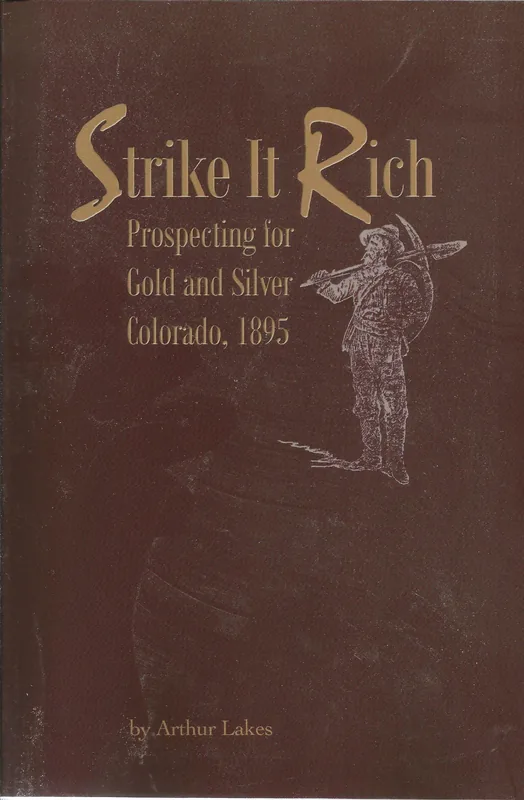
Strike It Rich
by Arthur Lakes
In the 1800s, Arthur Lakes, known as the “Father of Colorado Geology,” saw the need for a book that laymen could use in their quest for riches. Prospecting for Gold and Silver (reprinted as Strike it Rich) is as valuable now as it was over 100 years ago and is a “must read” for today’s historian or amateur prospector.
- Published
- 2010
- ISBN
- 978-1-932738-87-2
- Pages
- 214
- Category
- Reprints
- Place
- Colorado
- Publisher
- Western Reflections Publishing Company
- Listed at
- $20.45
Publication details from Open Library. The price shown is the last one on record and is historic, not a current offer.
- Direct from us info@westernreflectionspublishing.com or (336) 565-6915. We pack and post from Lake City.
- Amazon Buy from Amazon.
- Any bookshop Quote ISBN 978-1-932738-87-2 and your local bookseller can order it.
About this book
Strike It Rich is a reprint of a prospecting handbook written for ordinary people. Arthur Lakes, whom the description calls the Father of Colorado Geology, saw in the 1800s that laymen needed a book they could use in their quest for riches. The original is Prospecting for Gold and Silver, and this edition reissues it under a new name.
A library record for the original gives the imprint as Scranton, Pennsylvania: Colliery Engineer Company, 1895, with 207 pages, an index, illustrations and plans. Our reprint is dated 2010 in the catalogue. The handbook is aimed at amateurs rather than mining engineers, and the description says it remains as useful now as it was more than a century ago.
Wikipedia lists a longer form of the name, Prospecting for Gold and Silver in North America, also from the Colliery Engineer Company of Scranton. A bookseller may use either name for the same work.
Who it is for
Strike It Rich suits amateur prospectors, historians of the mining West and collectors of Colorado reprints. People interested in how 1890s mining knowledge was passed to beginners will enjoy reading the original advice in its own voice. It is a working manual from its period, so it is best used as a historical document, not as a modern field or safety guide.
Ways to use this book
Comparing an 1895 handbook with modern maps
Treat the book as history first. Before you pan anywhere, check the geological survey's current reports for the county you have in mind, and confirm who owns the ground and whether it is open to the public.
Researching a mining family or claim
If you are tracing an ancestor who prospected, request an appointment with the Mines archive and ask what its mining history holdings cover. Our Reprints and History categories at /library/ can add period reading.
Go deeper
A prospecting handbook invites a look at where Colorado's mining records are kept today. Two sources stand out: the mining history archive at the Colorado School of Mines and the state geological survey.
Mines Special Collections and Archives
A Colorado School of Mines guide that lists the Russell L. and Lyn Wood Mining History Archive among its collections. Its page says collections are accessible by appointment.
Colorado Geological Survey
The state agency housed within the Colorado School of Mines. Its site lists reports and maps, including a research note on gold and heavy mineral placer deposits in Moffat County.
Good to know
Is Strike It Rich a new book?
Who wrote it?
How many pages is it?
Where can I buy it?


Have a book of your own?
This is the kind of book the house publishes: regional history, biography, memoir and the stories that belong to a place. Send us yours and a person will read it.