
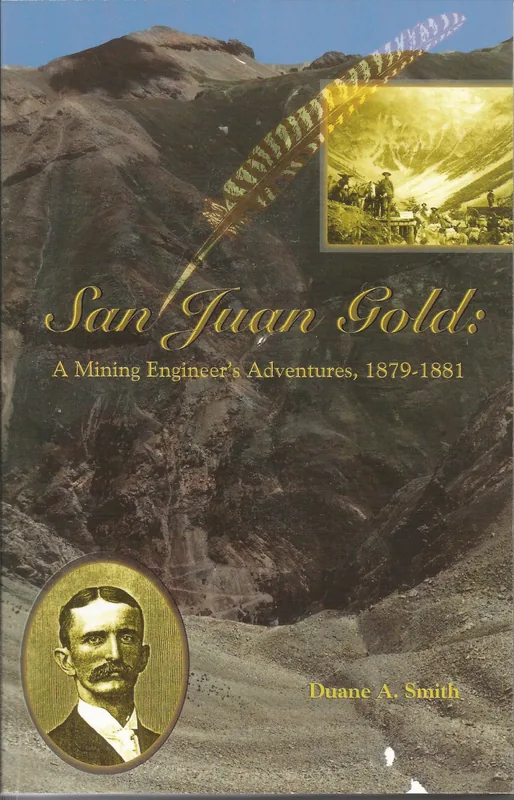
San Juan Gold
It is especially exciting when newly discovered material is made available on the Old West; but the well-written letters of Eben Olcott also reveal a very different side of the rough and rowdy mining frontier that dominated Colorado in the 1880s. San Juan Gold illuminates the details of daily life during that age from the perspective of an educated, successful mining engineer. Olcott's adventures are amplified by the observations of well-known Colorado historian Duane Smith, who does a masterful job of helping us to understand the historical context within which Olcott is working. Olcott traveled through out the West as a mining engineer, but Duane Smith has focused on his letters that deal with the nineteenth century Colorado mining industry as a whole with special emphasis on the mines of the San Juan Mountains. Unlike the traditional stereotype of nineteenth century mining, the reader will find Olcott's love of nature and the environment to be especially interesting.
- Published
- 2002
- ISBN
- 1-890437-67-0
- Pages
- 144
- Category
- History
- Place
- The San Juans
- Publisher
- Western Reflections Pub.
- Listed at
- $13.97
Publication details from Open Library. The price shown is the last one on record and is historic, not a current offer.
- Direct from us info@westernreflectionspublishing.com or (336) 565-6915. We pack and post from Lake City.
- Amazon Buy from Amazon.
- Any bookshop Quote ISBN 1-890437-67-0 and your local bookseller can order it.
About this book
San Juan Gold is a book of letters. Eben Olcott was a mining engineer who wrote home about his work in Colorado in the 1880s, and the description says those letters show a different side of the rough and rowdy mining frontier. They come from an educated, successful professional rather than a gambler or a drifter.
Olcott traveled throughout the West, but the editor, historian Duane Smith, chose the letters that deal with the Colorado mining industry as a whole, with special emphasis on the mines of the San Juan Mountains. Smith adds observations to the letters so that readers understand the historical context Olcott was working in.
One surprise is promised in the description. Unlike the traditional stereotype of nineteenth century mining, the reader will find Olcott's love of nature and the environment especially interesting. The book is 144 pages, the catalogue says, and Open Library lists it as a 2002 edition from Western Reflections, filed under correspondence, gold discoveries, gold mines and mining, and mining engineers.
What is inside
Letters from the field
The core of the book is the well-written correspondence of Eben Olcott.
Daily life in the 1880s
The letters illuminate the details of daily life from the viewpoint of a mining engineer.
San Juan emphasis
Smith focuses on Olcott's letters about Colorado mining, especially the San Juan Mountains.
Historical context
Duane Smith explains the setting around each stretch of Olcott's adventures.
Love of nature
The description notes Olcott's appreciation of nature and the environment.
Who it is for
San Juan Gold is for readers who like primary sources and want to hear a miner of the period in his own words. History teachers can use the letters in class to complicate the image of the drunken, violent prospector. Hikers and drivers in the San Juans will enjoy knowing how an engineer saw the same mountains. Collectors of Western correspondence will value a book built on newly available material. It is short enough, at 144 pages, to read in a weekend, and the notes by Smith keep it from feeling like a pile of old mail.
About the author
Duane Smith is the historian who prepared this book, and he has nine books in our catalogue. San Juan Gold appeared in 2002, the same year as his short history of the Durango and Silverton railroad. His other books range from the whole Rocky Mountain frontier to a single Colorado newspaperman. His author page has the full list and a summary of what is known about his career.
The place and the period
Olcott's letters belong to a particular moment in San Juan history. The Utes ceded the region in the 1873 Brunot Agreement, which opened it to settlement, and mining camps such as Howardsville, Eureka and Silverton formed soon afterward. Wikipedia says Silverton was founded in 1874 and was incorporated in November 1885.
Getting ore out of those mountains was the great problem. The Denver and Rio Grande reached the new town of Durango in 1881, and its crews built the last 45 miles to Silverton in about nine months. The first trains arrived in July 1882, so an engineer writing earlier in the decade would have known the country before the railroad made it easier to reach.
As for Olcott himself, Wikipedia gives his dates as 1854 to 1929 and says he graduated from the Columbia School of Mines in 1874. It says he superintended gold mines in San Juan County, Colorado, and in Venezuela, and later served as president of the American Institute of Mining Engineers in 1901 and 1902.
Source: Wikipedia, Eben Erskine Olcott
Good to know
What kind of book is it?
Does it cover only the San Juans?
When was it published?
Who was Eben Olcott?


Have a book of your own?
This is the kind of book the house publishes: regional history, biography, memoir and the stories that belong to a place. Send us yours and a person will read it.