
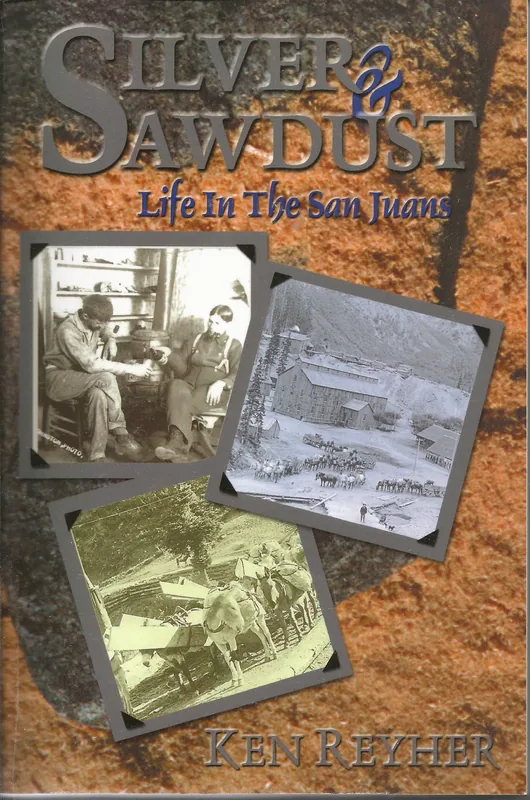
Silver & Sawdust
by Ken Reyher
Author Ken Reyher is a former history teacher and crop- dusting pilot. His articles have appeared in several national publications, he writes historical columns for two Western Slope newspapers, and he is a regional poet. Reyher has made several solo hikes along extended portions of pioneer trails using only the tools, food and clothing of a century and a half ago. He lives with his wife Jan outside Olathe, Colorado with their numerous horses and dogs. His first book, Antoine Robidoux and Fort Uncompahgre is also published by Western Reflections Publishing Company.
- Published
- 2000
- ISBN
- 1-890437-45-X
- Pages
- 204
- Category
- History
- Place
- Western Slope
- Publisher
- Western Reflections
- Listed at
- $18.29
Publication details from Open Library. The price shown is the last one on record and is historic, not a current offer.
- Direct from us info@westernreflectionspublishing.com or (336) 565-6915. We pack and post from Lake City.
- Amazon Buy from Amazon.
- Any bookshop Quote ISBN 1-890437-45-X and your local bookseller can order it.
About this book
Silver & Sawdust is a book about daily life in the San Juan mining camps of the late 1880s. Ken Reyher looks at towns that began as tent settlements and, within about a decade, grew into cities with telephones and electric lights. It was a boom that many people believed would last a hundred years.
It did not. The silver boom ended suddenly in 1893, and the book follows the people who lived through the rise and the end of it. A bookseller's description says Reyher profiles ordinary people, and covers their work, their leisure, their family life and their deaths against the scenery of the San Juans.
The catalogue's own description of this book is a biography of the author. It says Reyher is a former history teacher and crop dusting pilot, that he writes historical columns for two Western Slope newspapers, and that he has made solo hikes along stretches of pioneer trails using only the tools, food and clothing of a century and a half ago. Open Library lists the subjects as social life and customs and history, which fits a book more about people than about mines.
What is inside
Tent camps to cities
Towns that started as tent settlements grew into cities in about ten years.
Telephones and electric lights
The camps gained modern conveniences quickly during the boom.
A boom meant to last
Many people believed the boom would last a hundred years.
The end in 1893
The boom ended suddenly in 1893.
Ordinary lives
The book profiles workers, families and their leisure, and also their deaths.
The San Juan setting
The scenery of the San Juan Mountains frames the whole story.
Who it is for
Silver & Sawdust is for readers who like social history: how people worked, courted, raised children and buried their dead in a mining boom. San Juan Mountains travelers will recognize the region, and Colorado teachers can use it to give students a picture of everyday life rather than a list of mines and dates. Family historians may find it helpful for understanding what an ancestor in a mining camp might have faced. It is a nonfiction history, published in 2000 by Western Reflections.
About the author
Ken Reyher is a former history teacher and crop dusting pilot, a regional poet, and a columnist for two Western Slope newspapers. He has hiked pioneer trails alone with period gear. He lives with his wife Jan outside Olathe. Our author page for Reyher lists his other four books, beginning with his Robidoux biography.
The place and the period
The silver boom that Reyher's book describes belongs to a larger Colorado story. Wikipedia's article on the Colorado Silver Boom dates its start to 1879 with the silver discovery at Leadville. The Bland and Allison Act of 1878 had authorized silver coinage, and the Sherman Silver Purchase Act of 1890 nearly doubled government silver purchases.
The boom spread to new camps through the 1880s. Creede, for example, grew from about 600 people to more than 10,000 by December 1891. In total, over $82 million in silver was mined during the boom.
Then it ended. In 1893, repeal of the Sherman Act brought a collapse in silver prices, which ended the boom. Many mining camps became ghost towns afterward, and agriculture, once thought unfeasible in the state, grew into a major part of the economy. For the San Juans, that sudden end is the date that closes Reyher's book.
Source: Wikipedia, Colorado Silver Boom
Good to know
What years does the book cover?
Is it about mining technology?
Is it the author's first book?
How many pages is it?
Where can I buy it?


Have a book of your own?
This is the kind of book the house publishes: regional history, biography, memoir and the stories that belong to a place. Send us yours and a person will read it.