
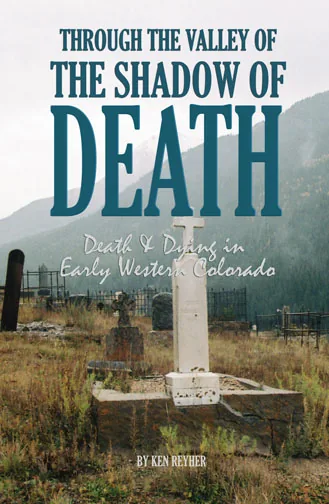
Through the Valley of the Shadow of Death
by Ken Reyher
Not only was living in the pioneer days of Colorado hard and difficult work, but death and dying was more painful and onerous too. Because of all the hardships they endured, people died a lot younger; and because of the lack of medicines and doctors, they often died of diseases or hazards that we wouldn’t even think of as deadly today. Often there were multiple deaths, perhaps even of entire families. Yet Reyher tells the stories of this part of pioneer life, not in a macabre and offensive way, but rather as tales of hope, courage, and survival for those who were left behind, as well as for those that knew they were dying. Religion and a fatalistic attitude also helped the women dying in childbirth or their children dying at a young age to do so with peace and comfort. The pioneers’ grit and strong eligious beliefs of all kinds helped survivors to get through their loss and continue on. Sometimes this was literally true, as family members died and were buried along the trail, their graves never to be seen again. At other times it was the event that sparked a new cemetery, so that others might have a place to bury and continue to return to their loved ones.
- Published
- 2009
- ISBN
- 978-1-932738-59-9
- Pages
- 176
- Category
- History
- Place
- Colorado
- Publisher
- Western Reflections Pub.
- Listed at
- $14.95
Publication details from Open Library. The price shown is the last one on record and is historic, not a current offer.
- Direct from us info@westernreflectionspublishing.com or (336) 565-6915. We pack and post from Lake City.
- Amazon Buy from Amazon.
- Any bookshop Quote ISBN 978-1-932738-59-9 and your local bookseller can order it.
About this book
Through the Valley of the Shadow of Death is a book about how ordinary people met dying in pioneer Colorado. Ken Reyher starts from a plain fact: life on the frontier was hard, and death came younger and more often than we expect today. With few doctors and little medicine, people died of illnesses and accidents that now seem survivable.
The description says some families lost several members, and sometimes an entire family. Reyher does not tell these stories to shock anyone. He frames them as accounts of hope, courage and survival, for the people who were left behind and for those who knew they were dying.
Two threads run through the book. One is faith: religion and a fatalistic outlook helped women who died in childbirth, and parents who lost young children, to face it with some peace. The other is the ground itself. People who died on the trail were buried where they fell, and their graves were never seen again, while other deaths were the reason a new cemetery was started. The Open Library subjects point the same way: burial, funeral rites and customs, cemeteries, and social life.
What is inside
Hardship and early death
The book opens with how hard pioneer life was and why people died so much younger than we do.
Diseases we no longer fear
Reyher covers illnesses and hazards that went unchecked for lack of doctors and medicine.
Families lost together
Some chapters of pioneer life saw several deaths at once, in some cases whole families.
Faith and fatalism
Religious belief and a fatalistic attitude are shown helping the dying and the bereaved.
Graves on the trail
Some family members were buried along the trail in graves that were never visited again.
How cemeteries began
At times a single death was the event that started a new cemetery for a community.
Who it is for
This book suits readers of Colorado and Western history who want the social side of the frontier rather than the battles and the booms. Genealogists and family historians can use it to understand what their pioneer ancestors faced. Local historical societies and cemetery volunteers will find the subject familiar ground. Because the author handles loss with care, it is also readable for anyone who wants to know how people got through grief before modern medicine. It is a nonfiction history of 176 pages, and it is not a horror book.
About the author
Ken Reyher writes about the Western Slope from the ground up. His own description calls him a former history teacher and crop dusting pilot living outside Olathe, Colorado. For a book on loss and burial, he writes with a local newspaper columnist's habit of telling stories about real people. His author page lists the other four books of his that we publish.
The place and the period
Cemeteries are one of the best records of pioneer life, and a visit to one shows what Reyher is writing about. Hillside Cemetery in Silverton, Colorado, spreads over twenty acres on the steep lower slope of Boulder Mountain, at more than 9,300 feet. Its headstones record causes of death from the frontier era, including the hazards of childbirth and early hard rock mining, along with the 1918 flu epidemic.
The San Juan County Historical Society page also shows how thin the record can be. Before author Freda Carley Peterson did her research, San Juan County had no record of the people buried there. Her two volumes, The Story of Hillside Cemetery, won a 1990 award from the American Association for State and Local History.
That is only one mountain town, and Reyher's book ranges across early western Colorado. Still, it shows why the subject matters: without someone writing these lives down, even the names of the dead can be lost. Reyher's book is part of that same effort to keep the record, told as a history of people rather than a list of graves.
Source: San Juan County Historical Society, Hillside Cemetery
Good to know
Is this book fiction or nonfiction?
Is it too grim to read?
How long is the book on pioneer death and when did it come out?
What is the book about besides death itself?
Where can I buy it?


Have a book of your own?
This is the kind of book the house publishes: regional history, biography, memoir and the stories that belong to a place. Send us yours and a person will read it.