
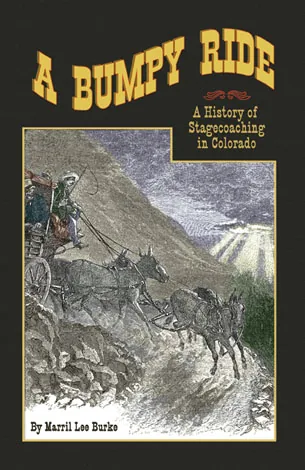
A Bumpy Ride
By the late 1860s stagecoaches were a new and exciting way to travel in Colorado. Hardly a Colorado town or mining camp could be found where stagecoach wheels had not left their tracks. The Colorado stagecoach was a thing of beauty, but it carried not only a large load of passengers but mail and express packages over some of the toughest roads in the country. Colorado stages often needed the addition of another pair of animals and because of the many dangers, the miles traveled in any specified length of time had to be greatly revised downward. In the winter wheels were often exchanged for runners so that the coach could travel through the deep Colorado snow. We can only imagine what it was realy like to traavel hundreds of miles in a swaying stagecoach with hard, wooden benches for seats, often having only a mere fifteen inches of space to yourself. Stage passengers often encountered rainstorms, wind, thunder and lightning, mud, snow and rockslides, all with only a thin piece of canvas to protect them from the inclement weather. But this was the premier way to travel. Passengers often overlooked the hardships and only remembered the speed, the beauty, and the excitement of a Colorado stagecoach trip.
- Published
- 2006
- ISBN
- 1-932738-30-4
- Pages
- 208
- Place
- Colorado
- Publisher
- Western Reflections Publishing
- Listed at
- $17.21
Publication details from Open Library. The price shown is the last one on record and is historic, not a current offer.
- Direct from us info@westernreflectionspublishing.com or (336) 565-6915. We pack and post from Lake City.
- Amazon Buy from Amazon.
- Any bookshop Quote ISBN 1-932738-30-4 and your local bookseller can order it.
About this book
A Bumpy Ride is Marril Lee Burke's history of stagecoaching in Colorado. Library records give the full title as A Bumpy Ride: A History of Stagecoaching in Colorado. It was published in 2006 under our Western Reflections imprint, and its ISBN is 1-932738-30-4.
The description sets the scene in the late 1860s, when stagecoaches were a new and exciting way to travel in Colorado. Hardly a town or mining camp existed where stagecoach wheels had not left their tracks. The Colorado coach, it says, was a thing of beauty, and it carried not only a large load of passengers but also the mail.
The book is a work of nonfiction. The Internet Archive's record notes that it includes a bibliography and an index, and Open Library credits P. David Smith as editor and Steven M. Burke as illustrator.
What is inside
Stagecoaches in Colorado
The book follows a form of travel that reached nearly every Colorado town and mining camp by the late 1860s.
Passengers and mail
The description notes that the coaches carried passengers and mail.
Stagecoach lines
Library subject headings include Colorado stagecoach lines and their history.
Stagecoach stations
Stations are a listed subject of the book, as the places where coaches stopped.
Illustrations
Steven M. Burke is credited as illustrator.
Who it is for
This book suits anyone interested in how people and mail got around Colorado before the railroads reached every corner of it. Local historians, genealogists tracing a family through a mining camp, and readers who enjoy Western transportation history will find a subject-focused history here. Because it includes a bibliography and an index, it also works as a starting point for research on a particular route or town. It is a book to look things up in as much as to read through.
About the author
We know Marril Lee Burke through her books rather than a long public biography. Library records list two of her books, A Bumpy Ride and The Ghosts of the Lake Fork Region, and we publish both. Her subjects are Colorado's past: its stagecoaches and stations, and the history of the Lake Fork of the Gunnison. Her author page lists both.
The place and the period
Stagecoach companies grew with Colorado's mining rushes. According to Legends of America, the firm of Barlow and Sanderson moved its headquarters to Junction City, Colorado, in 1866, and by 1869 it was focusing on expanding its Colorado routes because of the booming mining industry. In July 1870 it bought the Denver and Santa Fe Stage Line and renamed it the Southern Overland Mail and Express, and that December it moved its headquarters to Denver.
That is one company's story, and it shows the scale of the business the book's subject belongs to. Mail, passengers and freight moved on schedules that mining camps came to depend on.
Good to know
What is A Bumpy Ride about?
Is it fiction or nonfiction?
Who worked on it besides the author?
Where can I buy it?


Have a book of your own?
This is the kind of book the house publishes: regional history, biography, memoir and the stories that belong to a place. Send us yours and a person will read it.