
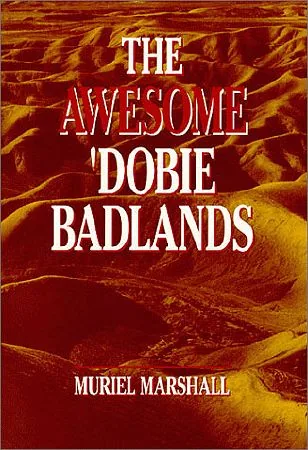
The Awesome 'Dobie Badlands
The Awesome 'Dobie Badlands (the locals never call them "adobe") skirt the base of mountain ranges in Utah, New Mexico and Arizona, but the most fascinating area is found along the Gunnison River in Southwestern Colorado. Here they push and twist in "pure abstract art form." Author Muriel Marshall explains the geology, gives photographic hints, describes the flora, tells us of people who lived here and makes us aware that much more has happened than we could ever imagine in what some would call "wasteland."
- Published
- 2000
- ISBN
- 1-890437-05-0
- Pages
- 123
- Category
- History
- Place
- Gunnison
- Publisher
- Western Reflections, Inc.
- Listed at
- $13.97
Publication details from Open Library. The price shown is the last one on record and is historic, not a current offer.
- Direct from us info@westernreflectionspublishing.com or (336) 565-6915. We pack and post from Lake City.
- Amazon Buy from Amazon.
- Any bookshop Quote ISBN 1-890437-05-0 and your local bookseller can order it.
About this book
The Awesome 'Dobie Badlands is a short, photographic look at one of Colorado's strangest landscapes. The title carries a local habit: people who live nearby never say adobe, they say 'dobie. The badlands skirt the base of mountain ranges in Utah, New Mexico and Arizona, but the description says the most fascinating area lies along the Gunnison River in southwestern Colorado.
There the bare hills push and twist in what Muriel Marshall calls pure abstract art form. She explains the geology, offers photographic hints, describes the flora and tells of the people who lived here. Her larger point is that far more has happened in this so-called wasteland than a visitor would ever guess.
Open Library lists the book as published by Western Reflections, Inc. in 2000, with the subject headings landscape, geology, description and travel, and pictorial works. The record we hold counts 123 pages, which fits the picture-forward approach.
What is inside
The geology
Marshall explains how these shaped, twisted hills came to be.
Photographic hints
She passes along advice for photographing the formations.
Flora
The book describes the plants that grow in this sparse country.
People of the badlands
It tells of people who lived here, adding human history to the geology.
Three states and one standout
The badlands appear in Utah, New Mexico and Arizona, but the book centers on southwestern Colorado.
A so-called wasteland
The theme is that much more has happened here than we could imagine.
Who it is for
This book is for photographers looking for unusual shapes and textures, hikers and day trippers around Delta and Grand Junction, and readers who like landscape and geology told for the general reader. It also suits teachers and families who want a pictorial book about a part of Colorado that most tourists skip. If you want trail directions and maps for backcountry travel, treat it as an introduction. It is a compact, illustrated book about a place, not a navigation manual.
About the author
Muriel Marshall wrote this book and two others in our library. She was a newspaper reporter before turning to books, according to a 1999 High Country News column, and she photographed her Uncompahgre guide. She also published Red Hole in Time with Texas A&M University Press in 1988. Beyond that, we have not found a biography we can verify, so we will not guess at one. Her author page has the other two books.
The place and the period
The Adobe Badlands lie in Delta County, Colorado, between the town of Delta and Grand Mesa. Wikipedia gives the area as 10,320 acres, made of Mancos Shale, and says the Bureau of Land Management owns and manages the wildlife study area, which overlaps a larger Area of Critical Environmental Concern.
The BLM says the sparsely vegetated shale country is locally called the dobies. The north is mostly flat with occasional hills, while the south is more rugged, with steep ridges cut by winding canyons. The shale holds ancient marine deposits with many fossils, and the Devil's Thumb, a scenic pinnacle, is a predominant feature.
Plants include low saltbush, desert trumpet, buckwheat, grasses and the Uinta Basin hookless cactus, with pinyon and juniper in the far north. Deer, elk, pronghorn, prairie dogs, badgers, coyotes, bobcats, red-tailed hawks and golden eagles live there. There are no formal trails or water sources, and wet clay is hard to walk across, which is useful context for any reader tempted to follow a photograph.
Good to know
Why is the title spelled 'Dobie?
Where are the badlands?
Does the book include photographs?
Where can I buy it?


Have a book of your own?
This is the kind of book the house publishes: regional history, biography, memoir and the stories that belong to a place. Send us yours and a person will read it.