
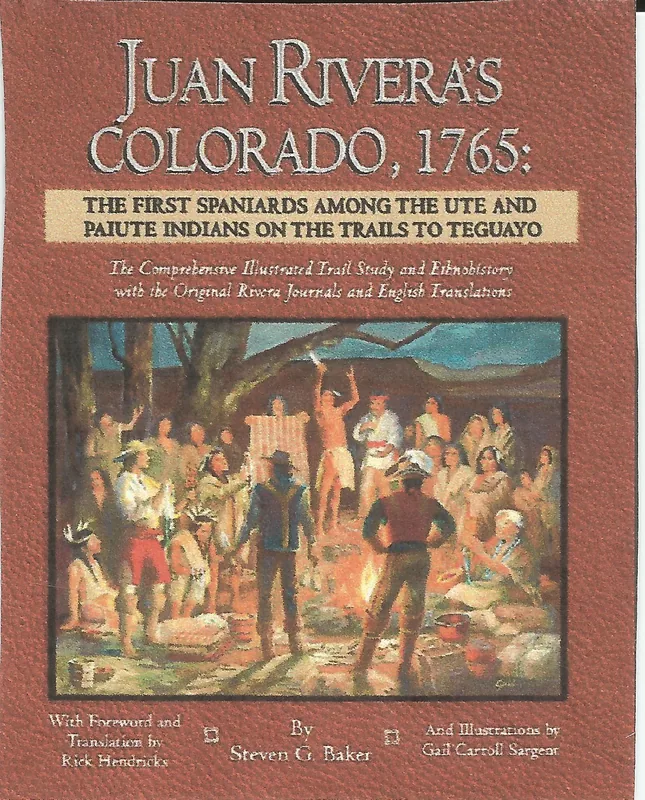
Juan Rivera's Colorado, 1765:
Should be read by anyone interested in early Spanish exploration and the history of Colorado and its native peoples. This ground-breaking volume includes Rick Hendricks’s thoughtful English translations of Rivera’s Spanish narratives of his two trips into western Colorado. Through meticulous scholarship and the help of copious original color illustrations by Gail Carroll Sargent, Steven Baker becomes the first scholar to successfully trace the routes and explicate the context of Rivera’s travels and day-to-day narratives. Rivera provides the first meaningful descriptions of the Centennial State and its Ute and Paiute Natives. Written for both scholarly and popular audiences, Baker’s discussion of Rivera’s travels weaves a rich, readable, well-documented, and never-before-presented tapestry of one of the American West’s least understood Spanish expeditions. Rivera was sent northward from New Mexico to explore for silver and to locate and explore the mighty Colorado River. He was also charged with investigating accounts of strange heavily bearded men who looked like Europeans and were said to live along the river in the legendary province of Teguayo. Although he only got as far as the Gunnison River near Delta, Colorado, Rivera set the stage for the better-known 1776 journey of Fathers Domínguez and Vélez de Escalante. Baker demonstrates how the trip of these regional historical icons was in very large measure intended to complete Rivera’s failed mission to find the bearded men, which they succeeded in doing. In addition to proving the strong connections between Rivera’s and the Franciscans’ expeditions, Baker solves a major historical puzzle that has defied accurate explanation for nearly half a century. He demonstrates that Rivera traveled only in New Mexico and Colorado and did not reach Utah as is almost universally believed by historians today. In accomplishing this, Baker corrects a massive mistake in the historical writing of the American West and returns Rivera to his rightful place as a corner stone in the foundation of Colorado's historical patrimony. This book is in full color with special color drawings and maps. It is hardbound with a dustjacket and is 404 pages long.
- Published
- 2015
- Pages
- 404
- Category
- History
- Place
- Gunnison
- Listed at
- $69.95
Publication details from Open Library. The price shown is the last one on record and is historic, not a current offer.
- Direct from us info@westernreflectionspublishing.com or (336) 565-6915. We pack and post from Lake City.
- Amazon Search Amazon for this book. Out of print books usually turn up through marketplace sellers.
About this book
Juan Rivera's Colorado, 1765 examines one of the American West's least understood Spanish expeditions. Rivera was sent north from New Mexico to explore for silver and to locate and explore the Colorado River. He was also charged with investigating accounts of strange, heavily bearded men who looked like Europeans and were said to live along the river in the legendary province of Teguayo.
Rivera only got as far as the Gunnison River near Delta, Colorado. Steven G. Baker argues that he nonetheless set the stage for the better-known 1776 journey of Fathers Dominguez and Velez de Escalante. According to the description, Baker shows that the Franciscans' trip was in very large measure meant to complete Rivera's failed mission to find the bearded men, which they succeeded in doing.
The book goes further than a retelling. The Colorado Encyclopedia gives its full title as Juan Rivera's Colorado, 1765: The First Spaniards Among the Ute and Paiute Indians on the Trails to Teguayo: The Comprehensive Illustrated Trail Study and Ethnohistory with the Original Rivera Journals and English Translations. The Encyclopedia credits Rick Hendricks as translator and Gail Carroll Sargent as illustrator.
What is inside
The mission north
Rivera leaves New Mexico to look for silver and to find and explore the Colorado River.
The bearded men of Teguayo
He is also told to investigate reports of heavily bearded men who looked like Europeans.
How far he got
The expedition reached the Gunnison River near Delta, Colorado, and no farther.
Link to 1776
Baker argues that the Dominguez and Velez de Escalante journey was largely meant to finish Rivera's mission.
The original journals
The full title promises the original Rivera journals with English translations.
Trail study and ethnohistory
The subtitle describes a comprehensive illustrated trail study and ethnohistory of the Ute and Paiute peoples Rivera met.
Who it is for
Juan Rivera's Colorado, 1765 is for readers of Spanish colonial history, people tracing the early trails of western Colorado, and anyone curious about the first written descriptions of the Ute people in this country. Researchers will value having the journals and translations in one volume. It is a large, scholarly book with a 404 page count in our catalogue, which suits libraries and serious students.
About the author
The Colorado Encyclopedia describes Steven G. Baker as an archaeologist and author based in Montrose, Colorado, whose work focuses on the early Spanish presence in what became Colorado. The same site credits him as author of its article on Juan Antonio Maria de Rivera. Our catalogue holds this one book under his name, and his author page has the record.
The place and the period
The Colorado Encyclopedia calls Juan Antonio Maria de Rivera the first Euro-American to intensively explore the territory that became Colorado. In 1765 he made two trips into western Colorado from New Mexico, reaching the Gunnison River in Delta County. His journals are the first detailed descriptions of the Ute and Paiute speaking peoples he met. Very little is known about the man himself. He is believed to have been baptized in Chihuahua in 1738, and he was about twenty-seven in 1765.
Governor Tomas Velez Cachupin had made peace with the Utes and received permission to search their land for silver, and he chose Rivera to lead the expeditions. The first began in June and went from Abiquiu to Chimney Rock near Pagosa Springs, then across southwest Colorado, naming rivers including the San Juan, Animas and Dolores. The second began in the fall. On it Rivera carved his name into a cliff in Roubideau Canyon, one of the oldest inscriptions in the western United States, and was turned back by Utes who said the route was too dangerous.
Good to know
Who was Juan Rivera?
What were the bearded men?
Does the book include the original journals?
When was it published?


Have a book of your own?
This is the kind of book the house publishes: regional history, biography, memoir and the stories that belong to a place. Send us yours and a person will read it.