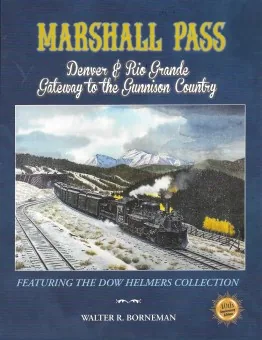
Marshall Pass
Marshall Pass atop the Continental Divide is one of the "great gates," as historian Marshall Sprague called the Rocky Mountain passes. In the early 1880s, General William Jackson Palmer's Denver and Rio Grande raced Governor John Evans's Denver, South Park and Pacific to reach the booming Gunnison country, tap the mineral wealth of the San Juan Mountains, and attempt to become a transcontinental route. Thanks to Marshall Pass, the Rio Grande won the race and for seven years was the only transcontinental line through Colorado.
- Published
- 2020
- Place
- Gunnison
- Listed at
- $29.08
Publication details from Open Library. The price shown is the last one on record and is historic, not a current offer.
- Direct from us info@westernreflectionspublishing.com or (336) 565-6915. We pack and post from Lake City.
- Amazon Search Amazon for this book. Out of print books usually turn up through marketplace sellers.
About this book
Marshall Pass sits on the Continental Divide in Colorado, and historian Marshall Sprague counted it among the "great gates" through the Rocky Mountains. This book tells how it became the key to the Gunnison country.
The setting is the early 1880s. General William Jackson Palmer's Denver and Rio Grande and Governor John Evans's Denver, South Park and Pacific were racing each other to reach the booming Gunnison country. The prize was the mineral wealth of the San Juan Mountains and the chance to become a transcontinental route.
According to the book's description, Marshall Pass decided the race in the Rio Grande's favor. For seven years afterward the Rio Grande was the only transcontinental line through Colorado. Our catalogue lists the book as published in 2020 and files it under Gunnison.
Who it is for
Marshall Pass suits readers of Colorado railroad history, and in particular anyone curious about the narrow gauge competition between two railroads over one mountain crossing. It will also interest people who drive or hike the old railroad grade, and those who follow how the Gunnison country and the San Juan mines were connected to the outside world. We have no author or table of contents on file, so we can't describe its chapters.
The place and the period
The pass takes its name from Lt. William L. Marshall of the Wheeler Survey, who is credited with finding it and naming it in 1873. A toll road over it opened in 1880, with stagecoach service between Gunnison and the Arkansas River.
In 1881 the Denver and Rio Grande Western built its narrow gauge mainline across the pass. Wikipedia describes this as Colorado's first railroad crossing of the Continental Divide, completed before the Denver, South Park and Pacific finished the Alpine Tunnel. The Gunnison Division line closed in 1955 and the rails were removed that year. A gravel road now follows the old railroad route over the pass.
Source: Wikipedia, Marshall Pass
Ways to use this book
Driving the old route
Ask the Forest Service about current road conditions before heading up, since high passes can close with snow. The route follows the old narrow gauge grade for part of its length, so go slowly and keep to the road.
Seeing the equipment
The railroad museum's yard lets you stand beside narrow gauge cars like the ones that raced over the Divide. Check its schedule first, then read the description of the race with those cars in mind.
Go deeper
The Denver and Rio Grande's climb over Marshall Pass belongs to a larger railroad story. These sources preserve railroad equipment, local history and public land along the route.
Colorado Railroad Museum
A railroad museum whose website says it has over 100 historic locomotives, passenger cars and cabooses on a 15 acre railyard.
Gunnison Pioneer Museum
The Gunnison County society's museum, which its website says has historic trains, wagons and original buildings. The site said it was closed for the 2026 season.
Gunnison National Forest
The Forest Service's official home for the Grand Mesa, Uncompahgre and Gunnison forests, with alerts and conditions for roads and trails.
Good to know
What does the book cover?
Is it fiction or nonfiction?
When was it published?
Who wrote it?


Have a book of your own?
This is the kind of book the house publishes: regional history, biography, memoir and the stories that belong to a place. Send us yours and a person will read it.