
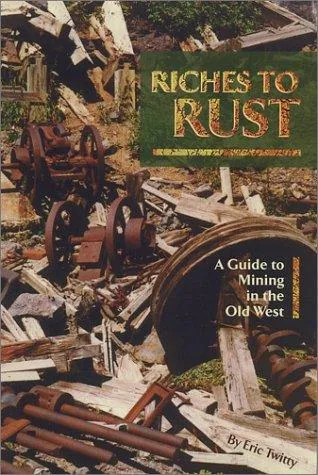
Riches to Rust
by Eric Twitty
Whether you are a tourist with a casual interest in old mine sites or a serious mining historian wanting to know more about mining methods, you will find Riches to Rust to be fascinating reading. Eric Twitty's new book can be used as a field guide for exploring the many old mine sites across the West and understanding the relics strewn around an abandoned mine, or it can be useful in understanding the processes involved in mining in the nineteenth century in the United States. It includes chapters on mine development and organization as well as details on prospecting, mining, milling and transporting the ore.
- Published
- 2002
- ISBN
- 1-890437-60-3
- Pages
- 390
- Category
- History
- Publisher
- Western Reflections Publishing Co.
- Listed at
- $32.32
Publication details from Open Library. The price shown is the last one on record and is historic, not a current offer. Cover image courtesy of Open Library.
- Direct from us info@westernreflectionspublishing.com or (336) 565-6915. We pack and post from Lake City.
- Amazon Buy from Amazon.
- Any bookshop Quote ISBN 1-890437-60-3 and your local bookseller can order it.
About this book
Riches to Rust is Eric Twitty's guide to mining in the old West, written to serve two readers at once. For a visitor standing in front of an abandoned mine, it works as a field guide to the relics strewn around the site. For a historian, it explains the processes behind nineteenth century mining in the United States.
The description says the book includes chapters on mine development and organization, along with details on prospecting, mining, milling and transporting the ore. Library catalog records add a subtitle, A Guide to Mining in the Old West, and list chapters on building surface plants, surface plants for mine tunnels and for shafts in the Gilded Age, mining during the Great Depression, and interpreting the remains of historic mines. An appendix holds tables for identifying machinery and facilities.
Open Library dates this book to 2002 and lists Western Reflections Publishing Co. as publisher. Its subject headings are mines and mineral resources, equipment and supplies, history, mining machinery and mine buildings. Library records describe a bibliography and an index. The record we hold says 390 pages and library catalogs say 383, so we give no page count.
What is inside
Mine development and organization
Chapters explain how mines were set up and run.
Prospecting and mining
The description covers both prospecting and the mining itself.
Milling and transporting ore
It details how ore was milled and moved out.
Surface plants
Catalog records list chapters on surface plants for tunnels and for shafts in the Gilded Age.
Reading ruins
A chapter on interpreting the remains of historic mines helps with identifying what you see on site.
Identification tables
An appendix of tables helps identify surface plant machinery and facilities.
Who it is for
Riches to Rust is for hikers and four wheel drivers who come across old mine sites and wonder what the rusted equipment did. It also suits mining historians, preservationists, and museum interpreters who need to describe nineteenth century methods accurately. The description puts both the tourist with a casual interest and the serious mining historian in its audience. Libraries in mining states will find the bibliography and index useful. It is long and detailed, so expect a reference you return to rather than a one sitting read.
About the author
Eric Twitty also wrote Blown to Bits in the Mine and Basins of Silver for Western Reflections. Together with this book, they make up the three Twitty books in our library, all of them about mines. We looked for a biography of Twitty and found none we could verify, so we leave it out rather than guess. For a closer look at the other two books, use his author page.
The place and the period
Much of what Riches to Rust teaches you to read is the machinery of crushing and milling. Wikipedia explains that a stamp mill crushes ore by pounding it: heavy steel stamps slide up and down in a frame, lifted by cams on a rotating shaft, and fall to crush the rock. Each frame and stamp set is a battery, and mills are often named by stamp count.
Because stamp mills were large, their remains often appear at abandoned sites as rows of foundation sets. Ore processing used a lot of water, so mills were often built near water. The first United States stamp mill was built in 1829 at the Capps mine near Charlotte, North Carolina, and in Colorado two Nissen stamps were installed around 1909 at the Sound Democrat Mill near Silverton.
Underground, hard rock mining reached ore through adits, which are horizontal tunnels driven into a hillside, or shafts, which are vertical excavations beside the ore body. Development work included drilling the face, loading explosives and blasting. Those are the same working parts a visitor may still spot at the portals and headframes the book helps identify.
Source: Wikipedia, Stamp mill
Good to know
Can I use it as a field guide?
What period does it focus on?
Does it explain mining methods?
Is it illustrated and indexed?


Have a book of your own?
This is the kind of book the house publishes: regional history, biography, memoir and the stories that belong to a place. Send us yours and a person will read it.