
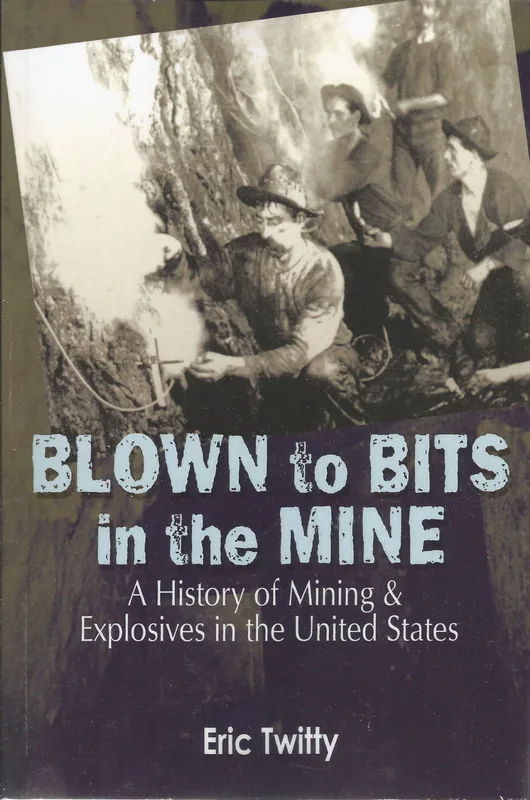
Blown to Bits in the Mine
by Eric Twitty
Interspersing tales of death and survival, author Eric Twitty details the evolution and use of explosives in the United States mining industry in an interesting and easy-to-read way. Providing information that dates from North America's Industrial Revolution into the twentieth century, Blown to Bits in the Mine is as much for the casual observer of western history as it is for explosive experts.
- Published
- 2001
- ISBN
- 978-1-932738-82-7
- Pages
- 220
- Category
- History
- Listed at
- $21.53
Publication details from Open Library. The price shown is the last one on record and is historic, not a current offer.
- Direct from us info@westernreflectionspublishing.com or (336) 565-6915. We pack and post from Lake City.
- Amazon Buy from Amazon.
- Any bookshop Quote ISBN 978-1-932738-82-7 and your local bookseller can order it.
About this book
Blown to Bits in the Mine is Eric Twitty's history of explosives in the United States mining industry. It follows how blasting went from a black powder necessity to a science, with tales of death and survival woven through the technical story so that it never reads like a manual.
The coverage begins with North America's Industrial Revolution and runs into the twentieth century. A dealer listing gives the full subtitle as A History of Mining and Explosives in the United States, and says the book covers the blasting process from drilling blast holes to firing charges, with attention to technology, material culture and what explosives did to the mine as a workplace.
The description says it is as much for the casual observer of western history as for explosives experts. The record we hold dates it to 2001. A dealer lists a 2009 first paperback edition, originally issued in hardcover, with endnotes, a bibliography and an index. The two lists of pages disagree, 220 in our record and 208 on the dealer's, so we give no page count.
What is inside
Tales of death and survival
Accounts of accidents and escapes are mixed into the technical history.
Evolution of explosives
The book details how mining explosives changed and were used over time.
From drilling to firing
A dealer listing says it covers the blasting process, from drilling blast holes to firing charges.
Industrial Revolution onward
The period runs from North America's Industrial Revolution into the twentieth century.
The workplace effect
The listing says it considers how explosives shaped the mine as a place to work.
Notes and index
The paperback edition carries endnotes, a bibliography and an index.
Who it is for
This book fits mining history readers, collectors of western Americana, museum volunteers who explain old mine equipment, and anyone curious why blasting mattered so much underground. The description says casual readers are as welcome as explosives experts. Engineers and teachers can use the endnotes and bibliography to follow sources. It is not a safety manual and should not be read as instructions; it is a history about how miners and companies used powerful materials, and what happened when things went wrong.
About the author
Eric Twitty wrote this book and two others in our library, Riches to Rust and Basins of Silver. All three concern mines and mining. The dealer listing we found carries no biography either. We could not find a verified biography of Twitty, so we do not offer one. His author page lists all three books.
The place and the period
Black powder was the main blasting agent in mining until nineteenth century chemistry changed the picture. Alfred Nobel, a Swedish chemist, developed dynamite in 1866, according to Wikipedia, and received patents in England on May 7, 1867 and in Sweden on October 19, 1867. Dynamite was the first safely manageable explosive stronger than black powder, and it quickly became a popular substitute.
Nitroglycerin had been the dangerous step before it. Wikipedia reports that an explosion at the Heleneborg factory on September 3, 1864 killed Nobel's brother Emil and several others. Nitroglycerin was unusable commercially until Nobel mixed it with diatomaceous earth, which stabilized it for transport and handling.
In the United States, the first dynamite production was by the Giant Powder Company of San Francisco, whose founder obtained exclusive rights from Nobel in 1867. DuPont later acquired Giant and dissolved it in 1905. After the DuPont monopoly was broken up in 1911 and 1912, Hercules Powder Company and Atlas Powder Company took over dynamite manufacturing. That industrial arc frames the period the book covers.
Source: Wikipedia, Dynamite
Good to know
What is the full title?
Is it fiction?
What period does it cover?
Is it only for experts?


Have a book of your own?
This is the kind of book the house publishes: regional history, biography, memoir and the stories that belong to a place. Send us yours and a person will read it.