
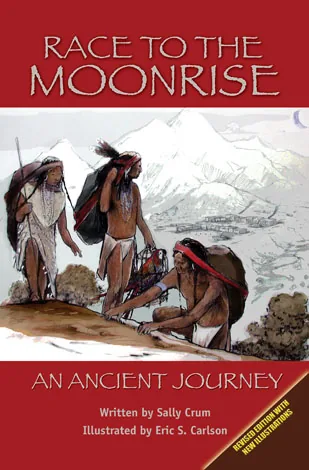
Race to the Moonrise
by Sally Crum
is an inviting story of Long Legs and Little Basket, two engaging children living in northern Mexico around 1200 A.D. who must journey afoot from their homeland all the way to what is now southwestern Colorado. Little Basket is a young girl with special powers; Long Legs is her rugged and protective older brother. To help the people of the Far North, with whom the gods are displeased, the two must hasten to visit many communities along the way to collect offerings to take to the Moonrise Ceremony. Not only do we get caught up in the race to the Moonrise and the children's remarkable adventures, we also learn about the early southwestern cultures along the way: the Mogollon of the Mimbres Valley in today's southwestern New Mexico, Arizona's Hohokam of the Gila and Salt River Basins, the Sinagua of Wupatki Pueblo and the Hopi. We also visit the Ancestral Pueblo people of Chaco Canyon, Aztec, Mesa Verde, and Chimney Rock. This book is a treasure for the young reader and an entertaining and informative yarn for adults.
- Published
- 1999
- ISBN
- 1-890437-21-2
- Pages
- 99
- Place
- Mesa Verde
- Publisher
- Western Reflections
- Listed at
- $12.95
Publication details from Open Library. The price shown is the last one on record and is historic, not a current offer.
- Direct from us info@westernreflectionspublishing.com or (336) 565-6915. We pack and post from Lake City.
- Amazon Buy from Amazon.
- Any bookshop Quote ISBN 1-890437-21-2 and your local bookseller can order it.
About this book
Race to the Moonrise is a children's adventure set around 1200 A.D. Two young people, Long Legs and his sister Little Basket, live in northern Mexico. Word comes that the people of the Far North have displeased the gods, and the pair set out on foot for what is now southwestern Colorado. Little Basket is a girl with special powers. Long Legs is her older brother, rugged and protective, and on the author's website he is described as training to be a long distance trader.
Their errand gives the story its pace. Along the way they stop at many communities to collect offerings for the Moonrise Ceremony, so every stretch of the road brings a new village and a new people. The book is fiction, and it is listed as juvenile fiction, but the places it visits are real ones. Readers pass through the Mimbres Valley, the Gila and Salt River basins, Wupatki Pueblo, Chaco Canyon, Aztec, Mesa Verde and Chimney Rock.
Sally Crum wrote it as a story first, with the history carried inside the plot instead of piled on top. Her own teacher's guide says the book can be read a chapter a day, and it lays out twelve chapters. The description calls it both a treasure for the young reader and an entertaining, informative yarn for adults, which fits a book that a parent and child can read together.
What is inside
A journey on foot
Long Legs and Little Basket travel from northern Mexico toward southwestern Colorado, and they make the trip afoot.
The Moonrise Ceremony
The children gather offerings from the communities they pass, to carry to the people of the Far North.
Mogollon and Hohokam country
They cross the Mimbres Valley of southwestern New Mexico and the Gila and Salt River basins of Arizona.
Sinagua and Hopi neighbors
The route includes Wupatki Pueblo, home of the Sinagua, and the Hopi.
Ancestral Pueblo places
Chaco Canyon, Aztec, Mesa Verde and Chimney Rock all appear along the road north.
A guide for classrooms
The author's teacher's and parent's guide offers discussion questions and activities for each of twelve chapters.
Who it is for
This book suits young readers who like a journey story and have never met the Ancestral Pueblo world. The author's guide aims at fourth through eighth grade students, and says older children and adults will enjoy it too. Teachers building a unit on the early Southwest will find a ready companion in the guide. Parents who plan a trip to Mesa Verde, Chaco or Chimney Rock can read it first. The book runs to about a hundred pages in our catalogue record.
About the author
Sally Crum has lived in western Colorado and the Four Corners area for over thirty years, according to her website. Most of her professional work has been archaeological survey for private contractors, the Navajo Nation and the U.S. Forest Service. She wrote this book and its sequel, Race to the River, for younger readers. Her author page here lists all three of her books with us, including a history of Colorado's tribes.
The place and the period
The places in this story were all part of a real Southwest. The National Park Service says Chaco Canyon's cultural flowering began in the mid 800s and lasted more than 300 years, and that by 1050 it was the ceremonial, administrative and economic center of the San Juan Basin. Roads linked the canyon's great houses to more than 150 others across the region, and Chaco may have been the hub of a turquoise trading network that brought in macaws, copper bells and shells.
Chimney Rock, where the children's trip ends, sits in Archuleta County between Durango and Pagosa Springs. About 2,000 people lived in the settlement between AD 925 and 1125, and its Great House Pueblo was first built in AD 1076 and finished in AD 1093. At the Moon's northern standstill it appears between Chimney Rock and Companion Rock for about 16 months, and the Great House went up during standstills in 1076 and 1093.
Good to know
Is Race to the Moonrise fiction?
When and where is the story set?
Is there a teacher's guide?
Has the book won any recognition?


Have a book of your own?
This is the kind of book the house publishes: regional history, biography, memoir and the stories that belong to a place. Send us yours and a person will read it.