
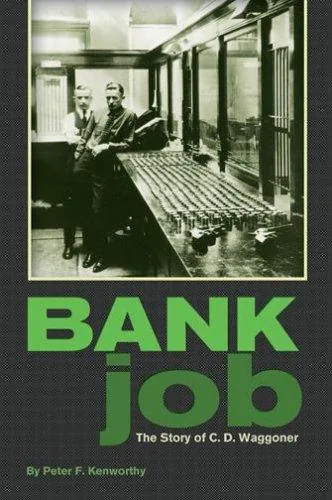
Bank Job
A banker as a hero or a villain is unusual, but C.D. Waggoner may have been both. In 1929, when the great stockmarket crash occurred, Waggoner was president of a small bank in the dying mining community of Telluride, Colorado. By manipulating several New York banks, Waggoner was able to save the deposits of everyone in his community. His fame soon became legend. He was called "the Robin Hoof of the West." But there was a seedier side to the tale. Waggoner had a gambling problem. Was he just covering a theft? Author Peter Kenworthy was a banker in Telluride when he researched "the bank job of the century."
- Published
- 2005
- ISBN
- 978-1-932738-24-7
- Pages
- 264
- Category
- History
- Place
- Telluride
- Publisher
- Western Reflections Publishing Co.
- Listed at
- $15.95
Publication details from Open Library. The price shown is the last one on record and is historic, not a current offer. Cover image courtesy of Open Library.
- Direct from us info@westernreflectionspublishing.com or (336) 565-6915. We pack and post from Lake City.
- Amazon Buy from Amazon.
- Any bookshop Quote ISBN 978-1-932738-24-7 and your local bookseller can order it.
About this book
Bank Job tells the story of C. D. Waggoner, president of a small bank in Telluride, Colorado, in 1929. The description poses a question it expects you to argue over: was Waggoner a hero, a villain, or both? When the stock market crashed that year, he is said to have manipulated several New York banks to save the deposits of everyone in his community.
The legend that followed called him the Robin Hoof of the West, as the description spells it. The book also looks at the seedier side. Waggoner had a gambling problem, and the question hangs over the story of whether the rescue was really a cover for a theft. The author, Peter Kenworthy, was a banker in Telluride when he researched what he calls the bank job of the century.
Who it is for
Bank Job is for readers of Colorado and Western Slope history who like a true story with a moral puzzle. Telluride visitors who have seen the plaque on the old bank building will find the background. People with a banking or finance career may like that the author worked in the trade himself. It does not read as a general history of the Depression: it follows one man and one town, and it leaves you to decide how you feel about him.
The place and the period
The outline of the real case is on record. Charles D. Waggoner joined the Bank of Telluride as a bookkeeper in 1896, became cashier in 1907 and president in 1919. In late summer 1929 he sent coded telegrams to six New York banks, posing as their Denver correspondents, and had a total of $500,000 moved to the Telluride bank's account at Chase National Bank.
The scheme came apart when the New York banks checked the orders with their real Denver correspondents. Waggoner was arrested at a tourist resort near Newcastle, Wyoming, and charged on six federal counts of using the mail to defraud. He received ten years in the Atlanta Penitentiary and began serving in November 1929. He was paroled in May 1935.
Telluride has never quite settled the argument. A plaque on the Bank of Telluride building at 109 West Colorado Avenue marks what it calls The Great Waggoner Swindle. A financial magazine article on the story notes that the plaque recalls his exploits with considerable fondness, and that the town had been shrinking as its mines turned unprofitable in the 1920s.
Good to know
Is Bank Job nonfiction?
Who was C. D. Waggoner?
How many pages is it?
Where can I buy it?


Have a book of your own?
This is the kind of book the house publishes: regional history, biography, memoir and the stories that belong to a place. Send us yours and a person will read it.