
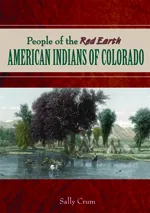
People of the Red Earth
by Sally Crum
Sally Crum’s People of the Red Earth: American Indians of Colorado, originally published in 1996, provides an engaging cultural tour of Ice Age mammoth hunters, archaic hunter-gatherers, and 12th century part-time farmers. The history, adaptability, and tenacity of more recent tribes are explored, including that of the Ute, Shoshone, Comanche, Arapaho, and Cheyenne. A new section in the book offers summaries of significant archaeological discoveries made since the original publication. Also included in this section is updated news about Colorado’s Native peoples, ancestral and present.
- Published
- 2009
- ISBN
- 978-1-932738-76-6
- Pages
- 308
- Category
- History
- Place
- Colorado
- Publisher
- Western Reflections Pub. Co.
- Listed at
- $29.95
Publication details from Open Library. The price shown is the last one on record and is historic, not a current offer.
- Direct from us info@westernreflectionspublishing.com or (336) 565-6915. We pack and post from Lake City.
- Amazon Buy from Amazon.
- Any bookshop Quote ISBN 978-1-932738-76-6 and your local bookseller can order it.
About this book
People of the Red Earth: American Indians of Colorado is a history of the state's first peoples, from Ice Age mammoth hunters to the tribes that live and are remembered there now. It was first published in 1996. This edition from Western Reflections adds a new section that summarizes significant archaeological discoveries made since the original appeared, along with updated news about Colorado's Native peoples, ancestral and present.
The tour runs in order of time. The early going covers the mammoth hunters, the archaic hunter-gatherers and the 12th century part-time farmers. Later the book turns to the more recent tribes and traces their history, adaptability and tenacity. The description names the Ute, Shoshone, Comanche, Arapaho and Cheyenne. Google Books describes the whole span as roughly 12,000 years, with the horse-and-buffalo warrior cultures of the Cheyenne and Arapaho among its focal points.
Crum's career was mostly archaeological survey work, and the book draws on it. Her own site says it combines archaeological research with the historical and ethnographic literature, and that the text is enhanced by her personal knowledge of the area. Google Books adds that it is illustrated with maps, drawings and historic photographs, and ends with a guide to archaeological sites, museums, cultural centers and other resources.
What is inside
Ice Age mammoth hunters
The book opens with the first people in Colorado, hunters of the Ice Age.
Archaic hunter-gatherers
The middle of the story follows the archaic peoples who lived by hunting and gathering.
Part-time farmers of the 12th century
The book also covers the farming peoples of the 12th century, who combined planting with other ways of living.
Tribes of the historic period
Later sections explore the Ute, Shoshone, Comanche, Arapaho and Cheyenne.
New archaeology since 1996
A new section summarizes significant discoveries made after the first publication.
Resources for visiting
Google Books lists a guide to archaeological sites, museums and cultural centers.
Who it is for
This is a book for Coloradans who want the deep history of the ground they live on, and for visitors planning a trip to museums and sites. Teachers and students will find a chronological outline, from the Ice Age forward. Hikers and rock art fans can use it to put what they see in context. Libraries with Native American studies shelves will want it, as will readers who enjoyed Crum's children's novels and now want the nonfiction behind them. It is a full reference rather than a pamphlet.
About the author
Sally Crum's website describes her as a longtime resident of western Colorado and the Four Corners, with fieldwork as the center of her career. In 2015 C-SPAN's Local Content Vehicles tour recorded her in Grand Junction, talking about this book. She also wrote two children's novels that we publish. Her author page lists them.
The place and the period
The Colorado Encyclopedia says people were certainly in what is now Colorado by 11,500 BC, leaving the distinctive spear points archaeologists call Clovis. Its best-documented Clovis evidence is the Dent site along the South Platte River near Milliken. A railroad foreman noticed large bones eroding from a gully there after heavy rains in April 1932, and a Regis College professor, Father Conrad Bilgery, identified them as mammoth.
Excavations in 1933 recovered partial skeletons of five adult female and eight young mammoths, along with two complete Clovis spear points. The Encyclopedia adds that Paleo-Indian sites are few and scattered, and that the surviving record is mostly animal bone and stone tools. That gap is why a book covering 12,000 years has to lean on archaeology, and why new discoveries keep changing the telling.
Source: Colorado Encyclopedia, Dent Site
Good to know
Is People of the Red Earth fiction or nonfiction?
When was it first published?
What is new in this edition?
Which tribes does it cover?


Have a book of your own?
This is the kind of book the house publishes: regional history, biography, memoir and the stories that belong to a place. Send us yours and a person will read it.