
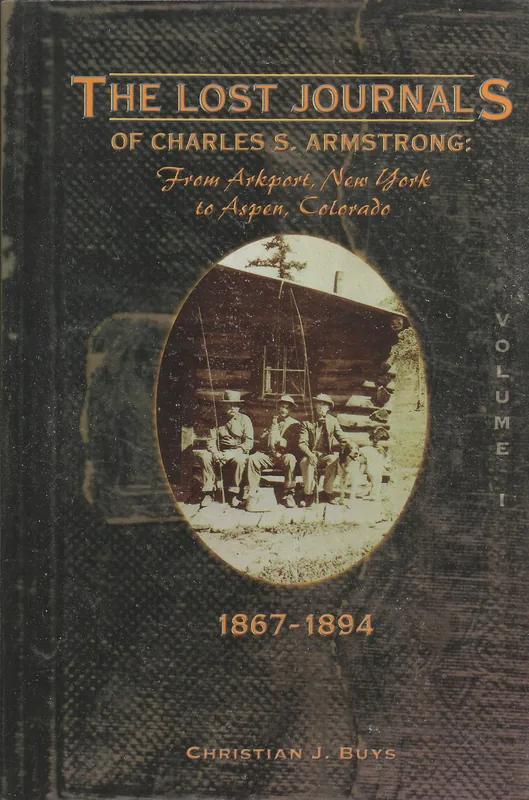
Lost Journals of Charles S. Armstrong
The newly discovered journals of Charles S. Armstrong offer the reader a rare opportunity to glimpse the never-before-revealed details of the daily life of an ordinary man in an extraordinary place and time. Armstrong's diaries capture the quintessential urge of a young man in nineteenth-century America to "Go West." It is also a unique, riveting record of one of the thousands of fortune seekers that poured into Colorado in the 1880s. Armstrong ended up visiting Aspen soon after it was founded, and he stayed, built a cabin, searched for valuable minerals, fished, trapped, enjoyed an active social life for a prospector, raised his own vegetables, traveled (to such places as the 1893 World's Fair in Chicago) and much more, all of which leaps at the reader from the pages of his journals. Nothing like his writing has been seen before in either Colorado or Western mining history.
- Published
- 2002
- ISBN
- 1-890437-66-2
- Pages
- 272
- Place
- Aspen
- Publisher
- Western Reflections Pub.
- Listed at
- $24.76
Publication details from Open Library. The price shown is the last one on record and is historic, not a current offer.
- Direct from us info@westernreflectionspublishing.com or (336) 565-6915. We pack and post from Lake City.
- Amazon Buy from Amazon.
- Any bookshop Quote ISBN 1-890437-66-2 and your local bookseller can order it.
About this book
Lost Journals of Charles S. Armstrong puts a nineteenth-century diary in your hands. The catalogue description calls the newly discovered journals a rare chance to glimpse the never-before-revealed details of daily life for an ordinary man in an extraordinary place and time. Armstrong was not a mining baron or a general. He was a young man with an urge, in the words of the description, that drove so many Americans west.
The full title spells out the route: From Arkport, New York to Aspen, Colorado, 1867 to 1894, as one bookseller lists it. That is twenty-seven years of a life, followed from a small New York village to a silver camp high in the Rockies. The book is credited to Christian J. Buys, and it is a softcover first edition from 2002.
Open Library files the book under correspondence, frontier and pioneer life, history and pioneers. That fits. A diary is the opposite of a grand narrative, and it is valuable for exactly that reason: it records what one person noticed on one day, without knowing how the story would come out.
What is inside
A young man's urge to go west
The description frames Armstrong's diaries as a record of the quintessential urge of a young man in nineteenth-century America.
Daily life, not headlines
The journals focus on the ordinary details of an ordinary man's days in an extraordinary place and time.
Arkport to Aspen
The subtitle follows Armstrong from Arkport, New York to Aspen, Colorado.
Twenty-seven years of entries
The dates on the title run from 1867 to 1894.
Primary source material
As Open Library classes it, the book belongs with pioneer correspondence and frontier life.
Who it is for
This book suits readers who like to meet history through a single voice rather than a survey. Genealogists and family historians will see how a nineteenth-century migrant kept records of his own days. Colorado and Aspen history readers get a worm's-eye view of the silver era, and teachers can use diary extracts as a classroom primary source. It is a long read, so it rewards patience over skimming. If you want a quick overview of Aspen's mining boom, a general history will serve better.
About the author
Christian J. Buys is the name on this book and on four others in our catalogue, all about Colorado's mining towns and their pictures. The edition record we hold does not tell us more about him, and we have not found a reliable biography, so we will not guess at one. His author page lists the other four books, which makes a useful next step if Armstrong's diary whets your appetite.
The place and the period
Armstrong's subtitle ends in Aspen, and Aspen's own story fits his dates closely. The Colorado Encyclopedia says Henry B. Gillespie established the first permanent mining camp on the Roaring Fork in 1879 and called it Ute City. B. Clark Wheeler surveyed the town site in 1880 and renamed it Aspen, and the first newspaper, the Aspen Times, began publishing in 1881.
Getting ore out was the hard part. The Denver and Rio Grande Railroad reached Aspen in 1887, and the Colorado Midland arrived by 1888. By 1891 Aspen had more than 5,000 people and had passed Leadville as the largest silver producing district in the United States. Two years later the Silver Panic of 1893 and the repeal of the Sherman Act hit the town hard. Armstrong's journal years, 1867 to 1894, cover both the arrival of that boom and its collapse.
Source: Colorado Encyclopedia, Aspen
Good to know
What years do the journals cover?
Is this a diary or a novel?
When was it published?
How can I order a copy of the Armstrong journals?


Have a book of your own?
This is the kind of book the house publishes: regional history, biography, memoir and the stories that belong to a place. Send us yours and a person will read it.