
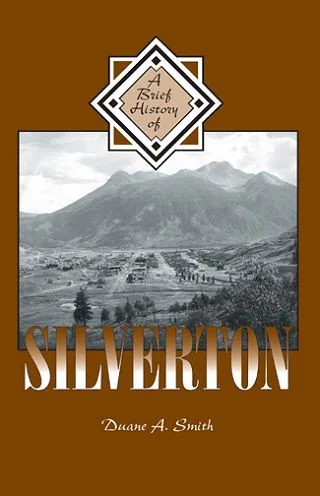
A Brief History of Silverton
Duane Smith, well-known Colorado historian, covers an amazing amount of history for such a "quick" history. He begins with the Spanish, then talks of the Colorado gold rush, the San Juan rush and the formation of the town. He discusses the importance of the railroad, the ties to Durango and reviews what it was like to live in this rough and tough mining town. He devotes whole chapters to baseball at 9,000 feet, the deadly influenza epidemic, and Silverton during World War II. There are several chapters describing mining life in one of the richest areas of Colorado. As Duane puts it,"Savor and learn, for the past has much to tell us."
- Published
- 2004
- ISBN
- 1-890437-95-6
- Pages
- 111
- Place
- Silverton
- Publisher
- Western Reflections Publishing Co.
- Listed at
- $13.97
Publication details from Open Library. The price shown is the last one on record and is historic, not a current offer.
- Direct from us info@westernreflectionspublishing.com or (336) 565-6915. We pack and post from Lake City.
- Amazon Buy from Amazon.
- Any bookshop Quote ISBN 1-890437-95-6 and your local bookseller can order it.
About this book
A Brief History of Silverton is Duane A. Smith's short history of the mining town in Colorado's San Juan Mountains. Our edition was published in 2004 as a paperback of 111 pages, and its ISBN is 1-890437-95-6.
The description promises a lot of ground for a quick read. Smith begins with the Spanish, moves on to the Colorado gold rush and the San Juan rush, and follows the formation of the town itself. From there he takes up the importance of the railroad and the ties between Silverton and Durango.
It is a book for getting your bearings. Library records file it under mines and mineral resources and under the history of Silverton, Colorado, and the Internet Archive's copy of the record notes a bibliography at the back. If you want one compact account of how a high mountain mining town came to exist and why it kept going, this is the place to start, and the longer books on the region will make more sense afterward.
What is inside
The Spanish first
The history opens with the Spanish, the earliest chapter of the story.
The Colorado gold rush
Smith places the San Juan story inside the wider Colorado gold rush.
The San Juan rush
He describes the rush into the San Juan country that led to Silverton's founding.
Forming the town
The book covers how the town was formed and organized.
The railroad
The description points to the railroad as a central part of Silverton's history.
Ties to Durango
The book looks at the connection between Silverton and Durango.
Who it is for
This book suits readers who are planning a trip to Silverton or who have just ridden the narrow gauge and want to know what they were looking at. It also works for people who collect Colorado mining history and want a short, single-author overview to sit beside longer studies. Teachers and students who need a quick, readable account of the San Juan rush will find the length helpful. At 111 pages it can be read in an afternoon, and the bibliography gives you a trail to follow if one chapter makes you want more.
About the author
Duane A. Smith was a historian who joined the Fort Lewis College faculty in Durango in 1964, and he wrote widely on Colorado mining history. The finding aid for his papers at the college's Center of Southwest Studies describes him as an author who wrote more books on Colorado history than any other scholar. We publish nine of his books. His author page lists them all.
The place and the period
Silverton sits in the Animas River valley in San Juan County, Colorado, a place first called Baker's Park. Wikipedia gives its establishment date as September 15, 1874, and says it was incorporated on November 15, 1885. Mining shaped everything about it. The same source says the region boomed after silver was found along Hurricane Peak, and that the town came through the collapse of the silver market in 1893 because gold mining carried it forward.
Rail travel changed the town too. The Silverton train depot dates from 1882, and the Durango and Silverton Narrow Gauge Railroad is still a famous part of the town. The entire town is now a federally designated National Historic Landmark District, designated July 4, 1961. That is the place Smith's short history sets out to explain, from the earliest Spanish presence to the railroad years.
Source: Silverton, Colorado (Wikipedia)
Good to know
What does A Brief History of Silverton cover?
Is it fiction or nonfiction?
How long is it?
Where can I buy it?


Have a book of your own?
This is the kind of book the house publishes: regional history, biography, memoir and the stories that belong to a place. Send us yours and a person will read it.