
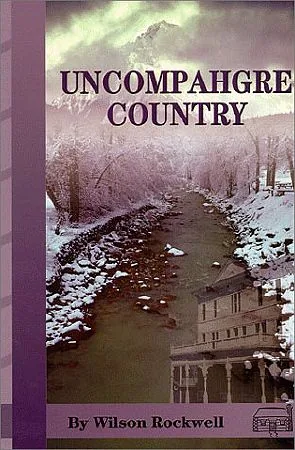
Uncompahgre Country
Uncompahgre Country tells the stories of the towns and the people of the area drained by the Uncompahgre River and its adjacent lands - a vast area that includes 14,000 foot peaks, thick evergreen forests, fertile irrigated valleys and desert wastelands. Rockwell not only describes the land, but the towns and the people who inhabit this colorful area of Western Colorado. Many of the towns are now gone but the author emphasizes not the past but a way of life.
- Published
- 1999
- ISBN
- 1-890437-38-7
- Pages
- 310
- Category
- Reprints
- Place
- Colorado
- Publisher
- Western Reflection
- Listed at
- $19.95
Publication details from Open Library. The price shown is the last one on record and is historic, not a current offer.
- Direct from us info@westernreflectionspublishing.com or (336) 565-6915. We pack and post from Lake City.
- Amazon Buy from Amazon.
- Any bookshop Quote ISBN 1-890437-38-7 and your local bookseller can order it.
About this book
Uncompahgre Country tells the stories of the towns and the people of the area drained by the Uncompahgre River and the lands next to it. It is a big piece of Western Colorado, and the description lists what's in it: 14,000 foot peaks, thick evergreen forests, fertile irrigated valleys and desert wastelands.
Wilson Rockwell does not stop at the scenery. He describes the towns and the people who live in this colorful part of the state. Many of those towns are gone now, and the description says the author stresses not the past but a way of life, which is a different goal from a plain chronicle of dates.
The book dates to Sage Books in Denver in 1965, according to library records. Our catalogue lists a reprint of 310 pages, and Open Library records the Western Reflections edition as published in 1999. Library catalogs note footnote references in the back, so readers can trace his sources.
What is inside
Peaks over 14,000 feet
The area drained by the river reaches into the high mountains.
Forests and irrigated valleys
The description pairs thick evergreen forests with fertile irrigated valleys.
Desert wastelands
The same country includes dry desert land.
Towns, many now gone
Rockwell tells the stories of towns, including some that no longer exist.
The people
The people who lived in the area are as central as the places.
A way of life
The author emphasizes how people lived over a list of past events.
Who it is for
This book is for anyone who knows Montrose, Ouray, Ridgway or Delta, or wants to. It suits people with family roots in the Uncompahgre valley and readers who enjoy ghost towns told through people rather than ruins. Travelers on the Western Slope will find it a good companion to a map. It also belongs on the shelf of any Colorado library that carries Rockwell's other books, since it covers a different corner of the Western Slope than his Ute history.
About the author
Wilson Rockwell, who also wrote about the Gunnison and North Fork valleys in New Frontier, is the author here. The University of Colorado Boulder finding aid for his papers lists him as a rancher, author and state senator for Montrose, Ouray, San Miguel and Dolores counties, so he knew the Uncompahgre valley as a representative as well as a writer. We publish five of his books, all listed on his author page.
The place and the period
The Uncompahgre River starts at Lake Como, at 12,215 feet in northern San Juan County, and runs about 75 miles to Delta, where it meets the Gunnison River. On the way it passes Ouray, Ridgway, Montrose and Olathe. The river's name comes from a Ute word that loosely means dirty water, red lake or red water spring.
Water shaped the valley. A public radio history says that before irrigation the valley was largely desert, drier on average than the Sonoran Desert in Arizona. In 1890 Frank Lauzon, a Montrose farmer and miner, proposed a tunnel from the Gunnison River, and many people thought the idea crazy. Surveyors in 1894 concluded a tunnel was the only workable route, though the valley could not afford one yet.
Montrose itself was founded in 1882, a year after the Utes were removed from the area. Today Gunnison River water reaches the valley through the Gunnison Tunnel, and the river itself irrigates farmland.
Source: Wikipedia, Uncompahgre River
Good to know
What area does the book cover?
Is it about ghost towns?
When was it first published?
Where can I buy it?


Have a book of your own?
This is the kind of book the house publishes: regional history, biography, memoir and the stories that belong to a place. Send us yours and a person will read it.