
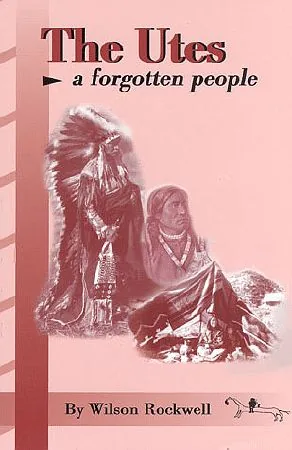
The Utes: A Forgotten People
When prospectors arrived in present-day Colorado in 1858, it was the Ute Indians who greeted them. These proud and independent Native Americans had inhabited this part of the Rocky Mountains for centuries. When originally printed in 1956, The Utes: A Forgotten People was the first published book devoted solely to an overall history of the Ute Indians. Wilson Rockwell undertook painstaking research and conducted many interviews so that he could extensively record the history of the early Native Americans who once dominated our region. Rockwell includes the fights, conflicts, customs, culture, history and famous leaders of the seven Ute bands who contributed so much to the history of western Colorado and Utah. This book has been used as the primary source of research for every book on the Utes written since.
- Published
- 1998
- ISBN
- 1-890437-23-9
- Pages
- 307
- Category
- Reprints
- Place
- Rocky Mountain
- Publisher
- Western Reflections
- Listed at
- $23.95
Publication details from Open Library. The price shown is the last one on record and is historic, not a current offer.
- Direct from us info@westernreflectionspublishing.com or (336) 565-6915. We pack and post from Lake City.
- Amazon Buy from Amazon.
- Any bookshop Quote ISBN 1-890437-23-9 and your local bookseller can order it.
About this book
When prospectors arrived in present-day Colorado in 1858, the Ute Indians greeted them. The Utes had lived in this part of the Rocky Mountains for centuries. The Utes: A Forgotten People tells their story, and when it first appeared in 1956 it was the first published book devoted solely to an overall history of the Ute Indians.
Wilson Rockwell did painstaking research and conducted many interviews to record the history of the early Native Americans who once dominated western Colorado and Utah. The book includes the fights, conflicts, customs, culture, history and famous leaders of the seven Ute bands. A bookseller listing adds that it has many photographs, most of the major Ute treaties and useful footnotes.
The description says it has been the primary source of research for every book on the Utes written since. We can't verify that claim on our own, so take it as the publisher's view, but the 1956 date and the first of its kind status are repeated in other listings. Our edition runs 307 pages.
What is inside
The seven Ute bands
The book covers the seven bands who shaped the history of western Colorado and Utah.
Fights and conflicts
Rockwell records the fights and conflicts of the early period.
Customs and culture
He describes Ute customs and culture as well as events.
Famous leaders
The leaders of the bands are part of the account.
Treaties
A bookseller listing says most of the major Ute treaties are included.
Photographs and footnotes
The same listing notes many photographs and useful footnotes.
Who it is for
This book is for readers of Ute history, Colorado history and Native American history who want an early and wide survey. Students looking for how the Utes were written about in the mid twentieth century will find it useful, as will anyone tracing treaty history. Local historians in western Colorado and eastern Utah can use the footnotes as pointers to further research. It is a reprint of a 1956 book, so read it as a mid century work and pair it with newer Ute scholarship.
About the author
Wilson Rockwell, described in library records as a former Colorado senator, did the research and interviews behind this book. The University of Colorado Boulder finding aid for his papers shows he served as a state senator for Montrose, Ouray, San Miguel and Dolores counties. He wrote the Ute history alongside histories of Western Slope towns and valleys. We publish five of his books, and his author page lists them.
The place and the period
The Denver Public Library describes three groups of Utes: the Northern Utes (Grand, Yampa and Uintah), the Southern Utes (Mouache, Capote and Weeminuche), and the central Tabeguache, or Uncompahgre, band led by Ouray. The government named Ouray chief of the Ute, though some Utes did not recognize that title.
Treaties came fast. In 1863 the Utes ceded hunting rights east of the Continental Divide, including Denver. The 1868 Hunt Treaty had the Utes cede the Yampa River valley and Middle and North Park. In September 1874 the Brunot Treaty gave up the San Juans.
After the 1879 White River War, the Utes were pushed out. On August 28, 1881, 1,458 White River Ute men, women and children set out under cavalry escort for a reservation in Utah, about 350 miles away. The Southern Ute and Ute Mountain Ute tribes remain the federally recognized tribes within Colorado's borders.
Source: Denver Public Library, Ute Removal and the Hunt Treaty
Good to know
When was the book first published?
Why is it called a forgotten people?
Does it include treaties and photographs?
Where can I buy it?


Have a book of your own?
This is the kind of book the house publishes: regional history, biography, memoir and the stories that belong to a place. Send us yours and a person will read it.