
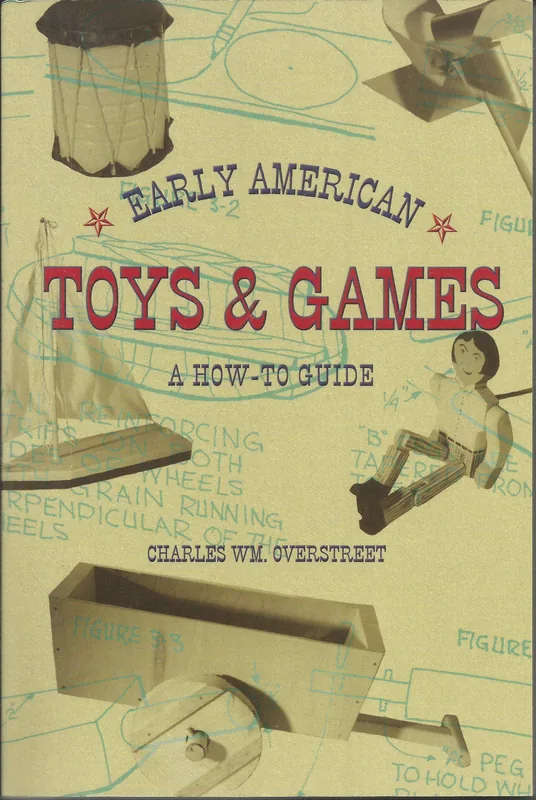
Early American Toys and Games
Instead of spending a small fortune buying the newest gadgets and electronic games, how about teaching our children the marvels of self-reliance, imagination, creativity, and a love of the great outdoors? Here are complete instructions on how to make seventy-five classic toys and instructions for playing forty-six classic games. Early American Toys & Games will show your child how to build a scooter, a sailboat, stilts, whistles, a periscope, and much, much more. There are games for the very young like London Bridge, Farmer In The Dell, and Train; or games for older children like Hopscotch, Crack the Whip, and Mumbly Peg. Whatever your choice, there are hours of educational entertainment for any child. Charles Overstreet has been writing about the early West for several years. Two of his previous books have won first place for the Rocky Mountain Outdoor Writers and Photographers annual writing contests. He spent years gathering, assembling and writing about these Early American toys and games for his latest book, which he hopes will bring back some of the fun and values of the past.
- Published
- 2002
- ISBN
- 1-890437-70-0
- Pages
- 220
- Category
- Children
- Place
- Rocky Mountain
- Publisher
- Western Reflections Publishing Company
- Listed at
- $13.97
Publication details from Open Library. The price shown is the last one on record and is historic, not a current offer.
- Direct from us info@westernreflectionspublishing.com or (336) 565-6915. We pack and post from Lake City.
- Amazon Buy from Amazon.
- Any bookshop Quote ISBN 1-890437-70-0 and your local bookseller can order it.
About this book
Early American Toys and Games is a how-to book for making things with your hands and playing outside. Charles William Overstreet gives complete instructions for seventy-five classic toys and rules for forty-six classic games. It runs 220 pages, and Open Library lists it as a first-edition paperback from August 2002.
The projects are practical. The description says the book will show a child how to build a scooter, a sailboat, stilts, whistles and a periscope, among much else. The games range from London Bridge, Farmer in the Dell and Train for younger children to Hopscotch, Crack the Whip and Mumbly Peg for older ones.
The pitch is simple: a child who builds a toy learns self-reliance, imagination and creativity, and spends time outdoors. Overstreet spent years gathering and assembling the material, and he hopes it brings back some of the fun and values of the past. It is a book to work through with a pencil and a pile of scrap wood nearby.
What is inside
Seventy-five toys to make
Step-by-step directions for classic homemade toys, including a scooter, a sailboat, stilts, whistles and a periscope.
Forty-six games to play
Rules for traditional games, so a group of children can start playing without special equipment.
Games for the very young
London Bridge, Farmer in the Dell and Train are named in the description as choices for younger children.
Games for older children
Hopscotch, Crack the Whip and Mumbly Peg are named as games for older children.
A theme of self-reliance
The book frames making your own toys as a way to teach imagination, creativity and a love of the outdoors.
Who it is for
This book suits parents and grandparents who want screen-free projects for a rainy weekend, and teachers or scout and camp leaders who need games that work with a group. Home-schooling families will find hands-on history here, since each toy and game is one that children played long before batteries. Collectors of Americana and craft hobbyists may enjoy it for the toy designs themselves. It is written about children and for the adults who help them, so expect to supervise any project that involves tools. Open Library files it under games, toys, handicraft and history, and that is a fair map of who will want it.
About the author
Charles William Overstreet wrote this book after years of collecting and assembling the toys and games it describes. The description says he has written about the early West for several years and that two of his earlier books won first place in the Rocky Mountain Outdoor Writers and Photographers annual writing contests. We have no further biography to offer. You can see his catalogue entry, and the separate entry that credits the same book to Charles Overstreet, on his author page.
The place and the period
Toys and games are some of the plainest records of ordinary life. The Strong, a museum in Rochester, New York, was founded in 1968 by Margaret Woodbury Strong, a collector of everyday objects who was especially fond of dolls and toys. It now describes its holdings as the world's largest and most comprehensive collection of historical materials related to play.
Colorado teachers use the same idea in the classroom. The Colorado Department of Education publishes a toys resource set built around real objects, including a pull toy from the 1920s and 1930s, a set of jacks from about 1920 to 1950, a board game from about 1900 and a Victorian doll from the 1860s to 1880s. Students read those objects as primary sources, the way they would read a letter or a photograph.
Overstreet's book works at the other end of the same idea. Instead of keeping old toys behind glass, it gives a child the directions to build one and the rules to play. That is the angle we like best about it, and it fits a publisher that has printed Western books since 1996.
Source: The Strong, About
Good to know
What will my child make from this book?
Does it explain how to play the games?
Is it fiction or nonfiction?
How can I buy a copy?


Have a book of your own?
This is the kind of book the house publishes: regional history, biography, memoir and the stories that belong to a place. Send us yours and a person will read it.