
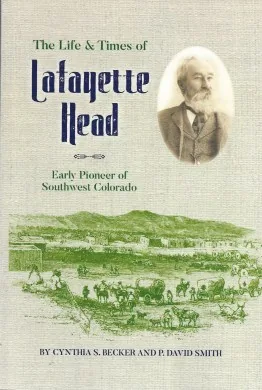
The Life and Times of Lafayette Head
by P. David Smith and Cynthia Simmelink Becker
He was involved with the Mexican Conejos Land Grant of over two million acres, started the first church in Colorado, dug the second earliest irrigation ditch, built the second flour mill in the state, and was a U.S. Marshall for three years.
- Place
- Colorado
- Listed at
- $26.95
The price shown is the last one on record and is historic, not a current offer.
- Direct from us info@westernreflectionspublishing.com or (336) 565-6915. We pack and post from Lake City.
- Amazon Search Amazon for this book. Out of print books usually turn up through marketplace sellers.
About this book
The Life and Times of Lafayette Head is a biography of a man whose name is tied to the earliest settlement of southern Colorado. The description credits him with a hand in the Mexican Conejos Land Grant of over two million acres, with starting the first church in Colorado, digging the second earliest irrigation ditch and building the second flour mill in the state. It adds that he served three years as a U.S. Marshal.
Outside sources give some of the same outline. Wikipedia says Head moved in 1854 into the lower San Luis Valley with about fifty Mexican families, was a pioneer in irrigation, and built one of the earliest flour mills in Colorado. It also says he served three years as U.S. Marshal for the northern district of New Mexico Territory, and that in 1859 he became Special Agent for the Ute and Jicarilla Apache Indians. He later became Colorado's first lieutenant governor, serving from November 1876 to January 1879 under Governor John Long Routt.
Our record for the book is limited to the description above. The publisher's old store page credits P. David Smith and Cynthia Simmelink Becker as the authors. We could not find a publication year, page count or table of contents from a source we could read, so we leave them out.
Who it is for
This book suits readers of Colorado and San Luis Valley history who want the story of one frontier figure rather than a survey. Anyone tracing Hispano settlement along the Conejos River, early irrigation, or the Ute agencies of the 1860s will find a name to follow. Local libraries and family historians in southern Colorado may also want it.
Ways to use this book
Tracing a San Luis Valley family line
Hispano families around Conejos have deep roots. Start with the county article for the land grant background, then ask the county clerk or a local church about parish and land records for the surnames you're chasing.
Seeing the valley in person
A day trip to Fort Garland pairs well with a drive toward Conejos. Check the History Colorado page for current visiting details, and bring the biography article to compare dates as you go.
Comparing sources on one frontier figure
Read the encyclopedia biography beside this book and note where dates or roles match, differ or add detail. Differences are worth a note, and the library's other southern Colorado books can fill in gaps.
Go deeper
Lafayette Head's story runs through the Conejos River settlements, Ute agency work and early Colorado politics. These resources cover the man, the county and the fort that guarded the valley.
Lafayette Head, Colorado Encyclopedia
A biography article that says Head led families from Abiquiu to the Conejos River in 1854, served as Indian agent, and became Colorado's first lieutenant governor.
Conejos County, Colorado Encyclopedia
Describes the county in the southern San Luis Valley and explains the Conejos and Guadalupe land grant, with a permanent settlement at Guadalupe in 1854.
Fort Garland Museum and Cultural Center
A History Colorado site in the San Luis Valley. Its page says the fort was an active army outpost from 1858 to 1883 and that adobe buildings still stand.
Good to know
Who was Lafayette Head?
Is this a biography or a novel?
What does the description say he did?
Where can I buy it?


Have a book of your own?
This is the kind of book the house publishes: regional history, biography, memoir and the stories that belong to a place. Send us yours and a person will read it.