
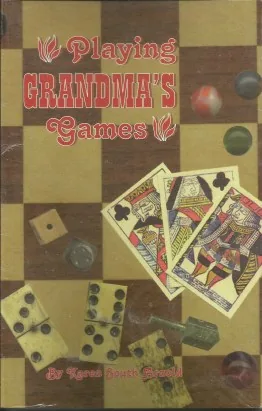
Playing Grandma's Games
Karen South Arnold, Ph.D., has enjoyed all kinds of games since childhood. Taught cribbage by her grandfather, she progressed to other games and holds bridge master points. Dr. Arnold has written a number of research articles on such diverse topics as animal biology and historical clothing patterns. She enjoys historical research and reenacting early American history through the fur trade period. Happily, she has focused her talents on her pastimes to produce Playing Grandma's Games. This is a book that will benefit not just reenactors, but also everyone with an interest in how games were played BC (before computers).
- Published
- 2000
- ISBN
- 1-890437-47-6
- Pages
- 160
- Publisher
- Western Reflections Publishing Company
- Listed at
- $16.13
Publication details from Open Library. The price shown is the last one on record and is historic, not a current offer.
- Direct from us info@westernreflectionspublishing.com or (336) 565-6915. We pack and post from Lake City.
- Amazon Buy from Amazon.
- Any bookshop Quote ISBN 1-890437-47-6 and your local bookseller can order it.
About this book
Playing Grandma's Games is a book about how people played before computers. Its author, Karen South Arnold, Ph.D., describes herself through the book's description as someone who has enjoyed games since childhood. Her grandfather taught her cribbage, she moved on to other games, and she holds bridge master points.
The description says she has written research articles on subjects as different as animal biology and historical clothing patterns. She also enjoys historical research and reenacting early American history through the fur trade period. This book brings those pastimes together.
According to the description, the book should help reenactors and also anyone interested in how games were played before computers. The catalogue lists the subjects as rules, games and history, so the book sets out how the games are played, with a historical angle.
Who it is for
This book is for reenactors who need period-appropriate amusements, and for people who like card games and parlor games and want to see how they were played. It also suits families who want to teach children games that need no screen. The description names reenactors first and then says the book is meant for everyone with an interest in how games were played before computers. Because the catalogue lists rules as a subject, expect instructions for playing, not only history.
Ways to use this book
Teaching cribbage to a grandchild
Take the rules from the American Cribbage Congress site first, and a plain board and deck will do. Play a few slow hands aloud, then compare notes with the book's version of the game.
Starting in living history
New to reenacting? Read the Museum of the Mountain Man rendezvous page, then check that site for the next event date before planning travel, since dates change each year.
Seeking out old toys and games
A teacher or collector who wants to see how play changed over time can start with the collection described on The Strong's about page.
Go deeper
The book covers traditional games and the fur trade era that its author reenacts. These sites cover play history, cribbage and the fur trade, for readers who want to try the games or see the period itself.
The Strong National Museum of Play
A museum in Rochester, New York that says it holds the world's largest and most comprehensive collection of historical materials related to play.
American Cribbage Congress
A nonprofit founded in 1980 that sanctions tournaments and clubs. Its site has rules and tips for people learning to play.
Fort Union Trading Post National Historic Site
A National Park Service history page on the American Fur Company post built in 1828 near the Missouri and Yellowstone Rivers.
Museum of the Mountain Man
Holds an annual Green River Rendezvous in Pinedale, Wyoming. Its site describes living history demonstrations of the Rocky Mountain fur trade.
Good to know
Is it a history or a rule book?
Who is it written for?
Who is the author?
Where can I buy it?


Have a book of your own?
This is the kind of book the house publishes: regional history, biography, memoir and the stories that belong to a place. Send us yours and a person will read it.