
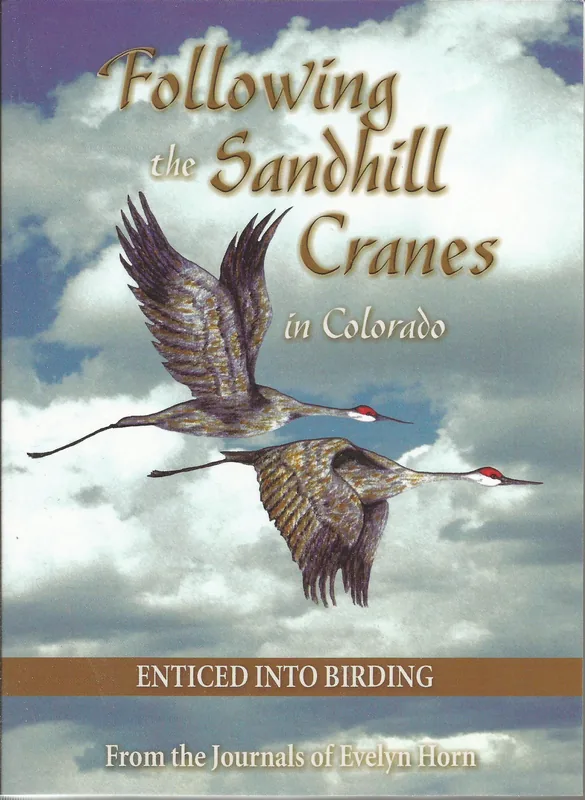
Following the Sandhill Cranes in Colorado
by Evelyn Horn
Following the Sandhill Cranes in Colorado is an intimate journey of discovery, as seen through the eyes of author Evelyn Horn. This captivating book expresses the author's love affair with nature. Birds are especially of interest; in particular, the majestic sandhill cranes that populate, among other places, Hart's Basin in western Colorado. Evelyn Horn writes with such an enthusiasm for her subject that readers cannot help but be steadily drawn into her work by the fascinating intricacies that make up the wonderful world of the birdwatcher. Following the Sandhill Cranes is filled with interesting facts regarding local fowl, and Evelyn Horn imparts her knowledge with such keen observations as to alert readers to bird behavior that many avid birdwatchers would fail to notice. With a compounding sense of excitement and wonder, Ms. Horn cheerfully invites readers to gaze into her spotting scope and witness first hand the beauty of these magnificent creatures.
- Published
- 2004
- ISBN
- 1-932738-05-3
- Pages
- 196
- Place
- Colorado
- Publisher
- Western Reflections Pub.
- Listed at
- $13.97
Publication details from Open Library. The price shown is the last one on record and is historic, not a current offer.
- Direct from us info@westernreflectionspublishing.com or (336) 565-6915. We pack and post from Lake City.
- Amazon Buy from Amazon.
- Any bookshop Quote ISBN 1-932738-05-3 and your local bookseller can order it.
About this book
Following the Sandhill Cranes in Colorado is a birdwatcher's book built from a diary. Open Library gives the subtitle as Enticed into Birding and says the text comes from the journals of Evelyn Horn. It was published in 2004, and the catalogue lists 196 pages.
The cranes are the center of it, especially the ones that gather in Hart's Basin in western Colorado. The description calls the book a love affair with nature and says Horn writes with real enthusiasm about the wider world of the birdwatcher. She also records facts about local birds and points out behavior that, in the description's words, many avid birdwatchers would fail to notice.
The tone is personal. Horn invites readers to look through her spotting scope and see the cranes for themselves, and a book kept as a journal lets you follow a year of watching rather than a field guide's list of species. Nothing here requires prior experience, only patience and an interest in what is outside the window.
What is inside
A year in seasons
The Library of Congress contents page is organized by season: cranes' spring, early summer, high summer, autumn, winter, and spring again.
Birds beyond the cranes
Chapter names include the eared grebe, American avocet, killdeer, great egret, American white pelican, Steller's jay and dipper.
Along the migration route
A section follows the cranes' travels, with chapters such as Cochetopa Pass and a fly-in at Bosque del Apache.
Cranes of the world
Appendix A covers cranes worldwide, including the whooping crane.
Bibliography and index
The record notes a bibliography and an index, so readers can follow up the reading.
Who it is for
Birdwatchers will get the most from this book, especially anyone who has stood in a cold field before dawn waiting for cranes. It also suits Colorado readers who live near Delta County or the Western Slope and want to know what the local birds are doing through the year. Nature journal keepers may like the diary form, and teachers or librarians building a regional natural history shelf will find a clear Colorado title here. Beginners are welcome, since the subtitle itself says the author was enticed into birding. Expect observation and enthusiasm rather than a scientific monograph.
About the author
Evelyn Horn kept the journals this book is drawn from, and the book's own subtitle describes how she was enticed into birding. Open Library lists her as the author of this one book, and our records show it is the only book of hers we publish. Beyond that, we have not found a verified biography, so we will not invent one. A 2013 public radio commentary in Delta County credits an Evelyn Horn with crane counts at Fruitgrowers Reservoir. Her author page has the catalogue details.
The place and the period
Sandhill cranes pass through Colorado twice a year. Colorado Parks and Wildlife says the Rocky Mountain population is about 20,000 birds. They winter in New Mexico, Arizona and Mexico and nest in Idaho, Montana and Wyoming. The greater sandhill is the largest subspecies in North America, standing about four feet tall with a wingspan up to seven feet.
Hart's Basin lies in Delta County, near the town of Eckert. A 2013 KVNF commentary says thousands of migrating cranes have traditionally stopped overnight at Fruitgrowers Reservoir there, and that the reservoir is a nationally designated Important Birding Area. The same piece reports that in 2013 the birds had shifted to the Escalante State Wildlife Area west of Delta, and that the local Crane Days festival was canceled that spring because too few cranes came through.
The festival has since returned. CPW's 2024 notice lists the 24th Eckert Crane Days for March 22 to 24, with viewing at Fruitgrowers Reservoir, and says more cranes now winter in the Delta area instead of flying farther south. Horn's book, written before those changes, records a stretch of crane history on the Western Slope.
Good to know
Is this a field guide?
Where do the cranes in the book live?
Does it cover birds other than cranes?
How can I get a copy?


Have a book of your own?
This is the kind of book the house publishes: regional history, biography, memoir and the stories that belong to a place. Send us yours and a person will read it.