
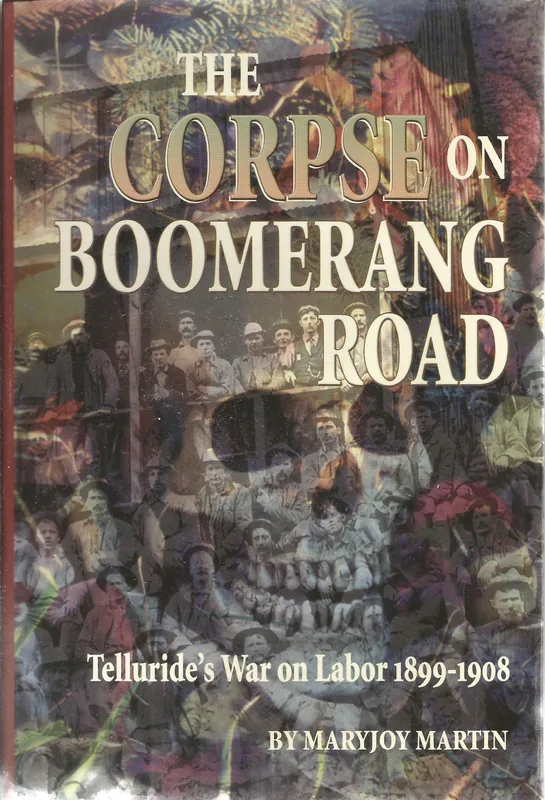
The Corpse on Boomerang Road
On August 8, 1907, newspapers in Telluride, Colorado, declared that the bones of William J. Barney had been recovered from a shallow grave on Boomerang Hill, thus proving the Telluride Miners' Union had butchered him in 1901. Many mine owners, newspaper editors, and Pinkerton detectives claimed the union had inaugurated a reign of terror with Barney's slaying, a nightmare of brutality that would end only when the union men and their families were driven from the region.
- Published
- 2004
- ISBN
- 1-932738-02-9
- Pages
- 392
- Category
- History
- Place
- Telluride
- Publisher
- Western Reflections Pub.
- Listed at
- $19.37
Publication details from Open Library. The price shown is the last one on record and is historic, not a current offer.
- Direct from us info@westernreflectionspublishing.com or (336) 565-6915. We pack and post from Lake City.
- Amazon Buy from Amazon.
- Any bookshop Quote ISBN 1-932738-02-9 and your local bookseller can order it.
About this book
The Corpse on Boomerang Road centers on one dead man, or a man said to be dead. Our description says that on August 8, 1907, newspapers in Telluride, Colorado, announced that the bones of William J. Barney had been recovered from a shallow grave on Boomerang Hill. They declared this proved the Telluride Miners' Union had butchered him in 1901. Mine owners, newspaper editors and Pinkerton detectives, the description adds, claimed the union had begun a reign of terror with Barney's killing, a nightmare of brutality that would end only when union men and their families were driven from the region.
The full title carries a subtitle: Telluride's War on Labor, 1899 to 1908. MaryJoy Martin's book runs 392 pages in our catalogue, and its subject headings are history, labor unions, miners and the Western Federation of Miners.
Wikipedia's article on William J. Barney, which cites this book repeatedly, describes him as a mine guard in Telluride who quit his job during a labor dispute without telling anyone. It places the story against the strike that began on May 1, 1901, when 350 union miners walked out of the Smuggler-Union mine over a pay method called contracting. The article also links the Barney case to the later trials over the assassination of former Idaho governor Frank Steunenberg.
Who it is for
This book speaks to readers of Colorado labor history, the Western Federation of Miners and the Telluride strikes.
Ways to use this book
Planning a stop in Telluride
If you're heading to the San Juan Mountains, look at the museum's website before you travel. It posts its own calendar and says when it closes for off seasons, so you can match your dates to what's open.
Placing 1901 in a wider story
Read the union article first, then the county article, and jot down the years each one gives. Lining those dates up against the 1899 to 1908 span in the book's subtitle shows which events were local and which belonged to a statewide fight.
Looking for more on the people involved
Ask the museum through its website whether it takes research questions, and bring the names and dates you want checked.
Go deeper
The story starts in Telluride in 1907 and looks back at the mining troubles of 1901. These four pages cover the town, the miners' union, the county, and the local museum that keeps Telluride's history.
Telluride Historical Museum
A local history museum whose website says it works in association with the Smithsonian Institution. Its events page lists programs such as cemetery tours, which tell the town's history through the people buried there.
Telluride, Colorado Encyclopedia
A short place history that says Telluride was founded as a mining center in 1878. It is a quick way to learn how the town grew before the labor fights.
Western Federation of Miners, Colorado Encyclopedia
An overview of the union founded in 1893, including the Colorado strikes it took part in. It puts a single town's dispute inside the larger story of hard rock labor.
Good to know
What event does the book start from?
What years does it cover?
How long is it?
Where can I buy it?


Have a book of your own?
This is the kind of book the house publishes: regional history, biography, memoir and the stories that belong to a place. Send us yours and a person will read it.