
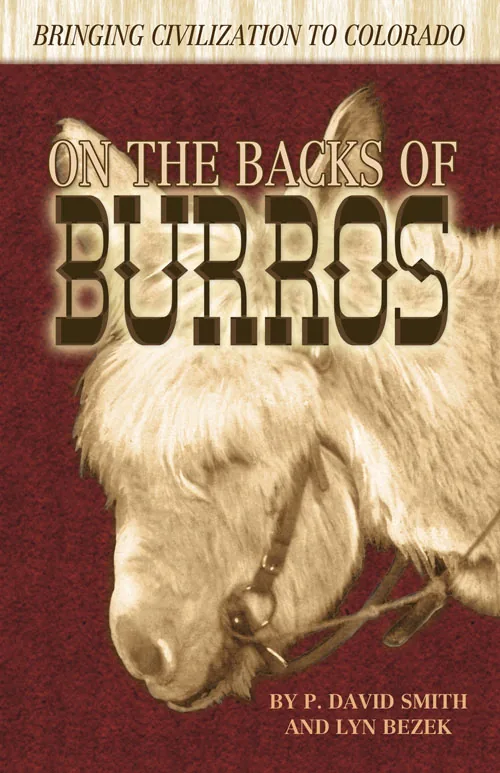
On the Backs of Burros - Bringing Civilization to Colorado
by P. David Smith and Lyn Bezek
Dating back to the Spanish exploration of the New World, the burro has been a special part of the land that is now called Colorado. And, despite abuse, ridicule, torture, and inhumane working environments, this little animal has maintained a dignity, trustworthiness, and unconditional affection that is legendary. On the Backs of Burros includes accounts about early Spanish settlers, Colorado prospectors, pack-train operators and present-day burro "employment," while detailing a history that starts with the burro's origin in Africa and ends with a look into its tenuous future. It is the hope of the authors that, with the help of this book, these forgotten symbols of the Old West will continue to bless Colorado with their unique and civilizing influence. A portion of the book's proceeds will be given to Colorado's Long Hopes, a donkey rescue mission.
- Published
- 2010
- ISBN
- 978-1-932738-94-0
- Pages
- 288
- Category
- History
- Place
- Colorado
- Publisher
- Western Reflections Publishing
- Listed at
- $23.68
Publication details from Open Library. The price shown is the last one on record and is historic, not a current offer.
- Direct from us info@westernreflectionspublishing.com or (336) 565-6915. We pack and post from Lake City.
- Amazon Buy from Amazon.
- Any bookshop Quote ISBN 978-1-932738-94-0 and your local bookseller can order it.
About this book
On the Backs of Burros is a history of the small animal that carried much of Colorado's early development. The description traces the burro back to the Spanish exploration of the New World and says it has been a special part of the land now called Colorado ever since.
The book follows the animal from its origin in Africa to a tenuous future. Along the way it includes accounts about early Spanish settlers, Colorado prospectors, pack-train operators and present-day burro employment. The description admits that the burro has suffered abuse, ridicule, torture and inhumane working conditions, and still kept a dignity, trustworthiness and unconditional affection that is legendary.
P. David Smith wrote it with Lyn Bezek, and the authors say they hope the book helps these forgotten symbols of the Old West keep blessing Colorado with their unique and civilizing influence. According to the description, a portion of the proceeds goes to Colorado's Long Hopes, a donkey rescue mission. Catalogue subjects include pack transportation, frontier and pioneer life, donkeys, care, and miners. Our catalogue dates the book to 2010.
What is inside
Origins in Africa
The history starts with the burro's origin in Africa and its arrival with the Spanish.
Early Spanish settlers
Accounts of early Spanish settlers who brought and used burros.
Prospectors and pack trains
Colorado prospectors and pack-train operators depended on burros.
Burros at work today
The book looks at present-day burro employment.
A tenuous future
It closes with a look at the animal's uncertain future.
Who it is for
This book is for anyone who has met a burro on a Colorado trail, watched a pack burro race, or wondered how mining camps got their supplies. Mining history readers will like the pack-train chapters, and animal lovers will appreciate the attention to care and treatment. It is also a fitting gift for families who visit the mountain towns where burros are celebrated. Because part of the proceeds supports a donkey rescue, buying it also helps the animals it describes. Teachers looking for a local history topic that students can connect with will find that the burro makes an easy way into the whole story of frontier Colorado.
About the author
P. David Smith wrote this book with Lyn Bezek, one of two books in our catalogue that Smith wrote with a co-author. We could not verify anything about Bezek beyond the credit. Smith's author page lists his other co-written book and the rest.
The place and the period
Wikipedia says the donkey descends from the African wild ass and was domesticated in Africa some 5,000 to 7,000 years ago. The first donkeys reached the Americas on Columbus's second voyage in 1495, landing at Hispaniola, and may first have reached what is now the United States in April 1598, crossing the Rio Grande with Juan de Onate.
In the gold rush years, the same article says, the burro was the preferred pack animal of early prospectors in the western United States. A 2005 Summit Daily article on Fairplay adds that burros were sure-footed enough to carry heavy loads on narrow trails above 10,000 feet, moving supplies in and ore out, and that they carried millions of dollars worth of gold and silver ore.
The tradition lives on in racing. Wikipedia reports that the earliest official pack burro race was organized in 1949 by the towns of Leadville and Fairplay, and that Colorado designated burro racing its official summer heritage sport in 2012.
Good to know
Is this a book about raising burros?
Who wrote it?
Does buying the book help burros?
Why doesn't the page list a page count?


Have a book of your own?
This is the kind of book the house publishes: regional history, biography, memoir and the stories that belong to a place. Send us yours and a person will read it.