
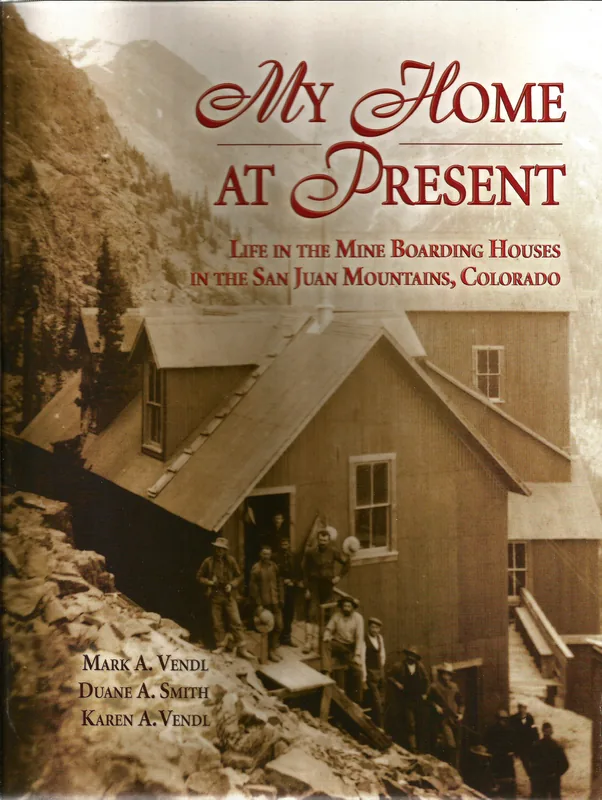
My Home At Present
Much has been written about the miner's life as he toiled underground, but that is only part of a very interesting story. My Home at Present relates the other half of the story, a time when the miner's daily life in the San Juan Mountains of Southwestern Colorado was often in a boardinghouse where he was fed with enormous amounts of food to keep his energy up. Sometimes he lived there with his fellow miners for months at a time, unable to get to town because of deep snows. It was almost as dangerous above ground as below, as he faced temperatures well below zero, hurricane force winds, the possibility of running out of food, and the ever present deadly avalanches. Yet it also could be a good life in which food was very edible as well as plentiful, libraries and poolrooms provided recreation, and the miners spent hours telling stories and playing cards.
- Category
- History
- Place
- The San Juans
- Listed at
- $32.32
The price shown is the last one on record and is historic, not a current offer.
- Direct from us info@westernreflectionspublishing.com or (336) 565-6915. We pack and post from Lake City.
- Amazon Search Amazon for this book. Out of print books usually turn up through marketplace sellers.
About this book
My Home at Present looks at the part of a San Juan Mountains miner's life that happened above ground. Many books describe the work underground. This one is about the boardinghouse, where a miner was fed large amounts of food to keep his energy up and where he sometimes lived with his fellow miners for months at a time.
The winter setting is the point. The description says deep snow could keep men from getting to town, and that life above ground was almost as dangerous as work below, with temperatures well below zero, hurricane force winds, the chance of running out of food, and avalanches that were always a threat.
It was not all hardship. According to the description, the food was edible as well as plentiful, libraries and poolrooms offered recreation, and the men spent hours telling stories and playing cards. A university library record lists the book as Mark A. Vendl with Duane A. Smith and Karen A. Vendl, in Lake City, Colorado, with black and white illustrations and plans.
What is inside
Boarding houses
A library record lists a chapter on the boarding houses themselves, with illustrations and plans.
The lodgers
Another chapter covers the men who lived in them.
Food
The description stresses the enormous amounts of food served to keep miners working.
Fire and ice
A chapter by that name sits alongside the description's account of cold, wind and avalanches.
What became of the residents
The library record lists a closing chapter on what happened to the people who lived there.
Bibliography and index
The same record notes a bibliography and an index.
Who it is for
This book suits readers of Colorado mining history who want the daily-life side of the story, and anyone who has stood at an old mine site in the San Juans and wondered how the men lived there. It also belongs on the shelf of people who research the high country, since it includes a bibliography and an index.
About the author
The book is credited to Mark A. and Karen A. Vendl. A library record names Mark A. Vendl with Duane A. Smith and Karen A. Vendl. A journal review elsewhere describes the Vendls as guides to the Silverton region and notes that Smith has worked with them on other projects. Their author page has more.
Ways to use this book
Planning a summer visit to Silverton
The Society's site said, when we read it, that its museums were closed for the season and would reopen around Memorial Weekend 2027. Check its current notice before you drive up, and read the Wikipedia page on Old Hundred first so you know what the boarding house looks like from the road.
Looking for a miner in your family
A great grandfather who worked the San Juans may show up in county records. Email the Society's archive with his name and the camp where you think he lived, and ask what it can search by mail.
Go deeper
The book concerns boardinghouse life for San Juan Mountains miners. Silverton, in San Juan County, is where several historic boardinghouses, archives and mining sites can still be studied, and the sources below are a practical start.
San Juan County Historical Society
The nonprofit that runs the Mining Heritage Center, the 1902 County Jail Museum and the Allen Nossaman Memorial Archive. According to its website, it also owns the Old Hundred Boarding House.
Old Hundred Gold Mine on Wikipedia
A short reference page placing the mine about five miles east of Silverton. It notes that the former miners' boarding house above the main entrance was stabilized with State Historical Fund money.
Center of Southwest Studies, Fort Lewis College
A research center whose website lists the Delaney Research Library and Archives, with separate contacts for archive and library questions.
Good to know
What does the book cover?
Is it fiction or nonfiction?
Does it include illustrations?
Where can I buy it?


Have a book of your own?
This is the kind of book the house publishes: regional history, biography, memoir and the stories that belong to a place. Send us yours and a person will read it.