
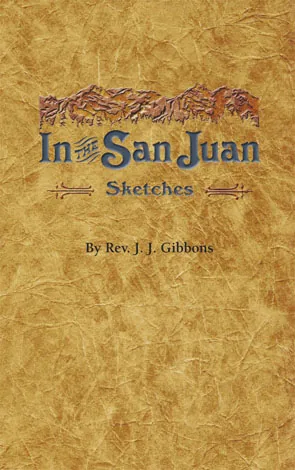
In the San Juan
Rev. J. J. Gibbons experienced the San Juan Mountains of Colorado as few men ever did. At the end of the Nineteenth Century, it was his job to tend to the sick, give last rites to the dying, bury the dead, and bring comfort to grieving families. Even when the weather was at its worst, Father Gibbons set out on foot or on horseback to bring comfort to those individuals in need of a Catholic priest. In the San Juan tells stories of skeletons along the trailside, men blown to bits while warming dynamite on a stove, and the power of avalanches that killed not only those in the way, but also would-be rescuers who came later. Responsible for an enormous territory that covered 10,000 sq. miles of some of the most rugged terrain in the United States, Father Gibbons was a living testament that faith in God helped good men to make it through terrible times.
- Published
- 2008
- ISBN
- 9781932738629
- Pages
- 216
- Category
- Reprints
- Place
- The San Juans
- Publisher
- Western Reflections Pub. Co.
- Listed at
- $18.29
Publication details from Open Library. The price shown is the last one on record and is historic, not a current offer.
- Direct from us info@westernreflectionspublishing.com or (336) 565-6915. We pack and post from Lake City.
- Amazon Buy from Amazon.
- Any bookshop Quote ISBN 9781932738629 and your local bookseller can order it.
About this book
In the San Juan is a reprint of a book first published in 1898. The original was titled In the San Juan, Colorado: Sketches, by Rev. J. J. Gibbons, and the Library of Congress copy shows it was printed in Chicago by the Calumet Book and Engraving Company, with the copyright dated 1898. Our edition came out in 2008 under the Western Reflections imprint, ISBN 9781932738629.
Gibbons was a Catholic priest, and this is his own account. He writes in the first person of the years after he was appointed to the parish of Ouray in August 1888, a parish that took in nearly the whole San Juan country. The catalogue description says his work was to tend the sick, give last rites, bury the dead and comfort grieving families, on foot or on horseback, in the worst weather.
The stories include skeletons along the trailside, men blown up while warming dynamite on a stove, and avalanches that killed those in their path and the rescuers who came afterward. His territory covered about 10,000 square miles of rugged country, and the book shows it through the eyes of a man who crossed it constantly.
What is inside
First experiences
The first sketch covers his arrival in the San Juan, a trip to Telluride, and Silverton in its Christmas attire.
Funerals and hard country
Later sketches describe a funeral in the Rockies, a skeleton that recalls a tragedy, and sudden storms.
Snowslides
One sketch takes in the Mother Cline snowslide, and another covers faithful friends lost in an avalanche.
Sick calls
A full sketch, Ten Days on a Sick Call, follows a long ride with a horse called Old Gray.
Mining camps and towns
Ouray, Telluride, Rico and Ironton all appear, including a Telluride bank robbery.
San Juan's future
The final sketch looks at Colorado among the states, how a mine is worked, and a miner's way of living.
Who it is for
This book is for readers of primary-source frontier writing. It will appeal to anyone researching Ouray, Silverton, Telluride or the wider San Juan Mountains in the 1890s, and to those who want to see mining country through the eyes of a priest rather than a prospector. Because it is a reprint of a Victorian memoir, its language and attitudes belong to its time, and it is best read as a record of one man's experience. Genealogists may also find names and places worth following up.
About the author
James Joseph Gibbons is the author named in the Internet Archive record of the 1898 book. In its opening pages he says that before his southwestern mission he did pastoral work at Georgetown and Leadville, and that he was a priest of the diocese of Denver. We know him through this book and not from a longer biography, so we have left out anything we could not confirm. The details on his author page come from the same source.
The place and the period
The San Juan Mountains in the 1890s were mining country, and the parish Gibbons describes was enormous. In his own words, when he was appointed, the parish included pretty nearly the whole of the San Juan country, and it held only two churches, one at Ouray and the other at Silverton, twenty-seven miles apart. There were twenty missions or stations, with new ones appearing as mines were discovered and sawmills put up.
He describes the territory as perhaps as large as the whole of Ireland, with sick calls that could involve trips of 150 miles, day or night. The book's twelve sketches run to page 194 in the original, and they move between Ouray, Silverton, Telluride, Dallas, Rico and the high camps in between.
Source: In the San Juan, Colorado; sketches (Internet Archive, Library of Congress copy)
Good to know
When was In the San Juan first published?
Is it fiction or nonfiction?
Is the text the original or a rewrite?
Where can I buy it?


Have a book of your own?
This is the kind of book the house publishes: regional history, biography, memoir and the stories that belong to a place. Send us yours and a person will read it.