
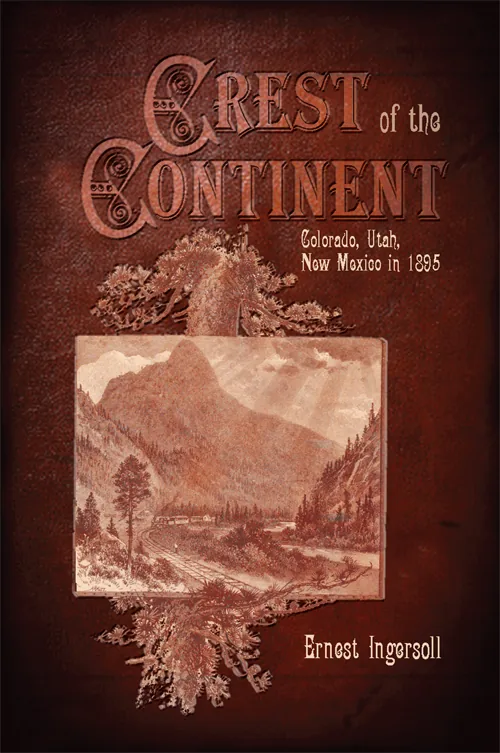
Crest of the Continent
Ernest Ingersoll, famous 19th century travel writer, set out to explore Colorado in the 1880s because "it was wild and rough" and caused "exhilaration of the body and soul." In Crest of the Continent, Ingersoll brings the "Colorado experience" to life better than anyone else before or since, with words and illustrations that record for all time what it was like to live in the Wild West.
- Published
- 2010
- ISBN
- 978-1-932738-88-9
- Pages
- 348
- Category
- Reprints
- Place
- Colorado
- Publisher
- Western Reflections Publishing Company
- Listed at
- $26.95
Publication details from Open Library. The price shown is the last one on record and is historic, not a current offer.
- Direct from us info@westernreflectionspublishing.com or (336) 565-6915. We pack and post from Lake City.
- Amazon Buy from Amazon.
- Any bookshop Quote ISBN 978-1-932738-88-9 and your local bookseller can order it.
About this book
Crest of the Continent is Ernest Ingersoll's account of a summer journey through the Rocky Mountains. Project Gutenberg gives the full title as The Crest of the Continent: A Summer's Ramble in the Rocky Mountains and Beyond. Our catalogue lists the Western Reflections edition under Reprints and dates it to 2010, so the words are nineteenth century ones. Wikipedia dates the original publication to 1885.
Our description quotes Ingersoll on why he went west: Colorado "was wild and rough," and it caused "exhilaration of the body and soul." The description adds that the book carries words and illustrations recording what it was like to live in the Wild West of the 1880s.
Project Gutenberg's summary says the narrative opens with the author's awe at first seeing the mountains, then introduces his companions, among them a musician, an artist and a photographer, who travel together in a chartered train. It also covers Denver, its rapid growth and its resources, before the party heads deeper into the mountains. That summary is machine generated, so read it as a pointer to the early chapters and not as a full contents list. Ingersoll wrote as a naturalist and travel writer, and the book moves as a journey does, place by place.
What is inside
Why Colorado
Ingersoll says he went because the country was wild and rough and made him feel exhilarated in body and soul.
A traveling party
The early chapters introduce companions including a musician, an artist and a photographer.
A chartered train
The group travels together in a chartered train on its way into the mountains.
Denver
The book looks at Denver's rapid growth and resources before heading deeper into the mountains.
Words and illustrations
Our description says the book records the Colorado experience in both text and pictures.
Who it is for
This book suits readers who want to see Colorado through the eyes of someone who traveled it while it was still being settled. It is a travel narrative, so it reads best as a journey and not as a reference guide. Anyone interested in the Rocky Mountains of the 1880s, in how Denver looked to a visitor of that time, or in nineteenth century travel writing will find a first-hand voice here. Because it is a reprint, the language and attitudes are those of its day.
About the author
Ernest Ingersoll was born in 1852 and died in 1946. Wikipedia describes him as an American naturalist, writer and explorer who served as zoologist on the 1874 Hayden survey and later updated Rand McNally guidebooks. Crest of the Continent is the one book of his in our catalogue. His author page gives a little more about his life and work.
The place and the period
Ingersoll was born in Monroe, Michigan, in 1852 and studied at Oberlin College and then Harvard, where he was a pupil of the naturalist Louis Agassiz. He began in journalism in 1874 with a New York Tribune article on Agassiz's work and joined the paper's staff. That same year he served as zoologist on the Hayden survey.
On that survey he and the photographer William Henry Jackson were among the first scientists to investigate and describe the Mesa Verde cliff dwellings. Later he described shellfisheries for a joint project of the U.S. Fish Commission and the Census Bureau, from 1879 to 1881. From the 1890s to 1905 he updated Rand McNally guidebooks.
He moved to New York City in 1900 and wrote a weekly column for a Montreal paper until he retired in 1938. He died in Brattleboro, Vermont, in November 1946 at the age of 94. Wikipedia lists Crest of the Continent among his works with a publication year of 1885.
Source: Wikipedia, Ernest Ingersoll
Good to know
Is Crest of the Continent fiction or nonfiction?
When was the original published?
Does it have illustrations?
Who travels with Ingersoll?
Where can I buy it?


Have a book of your own?
This is the kind of book the house publishes: regional history, biography, memoir and the stories that belong to a place. Send us yours and a person will read it.