
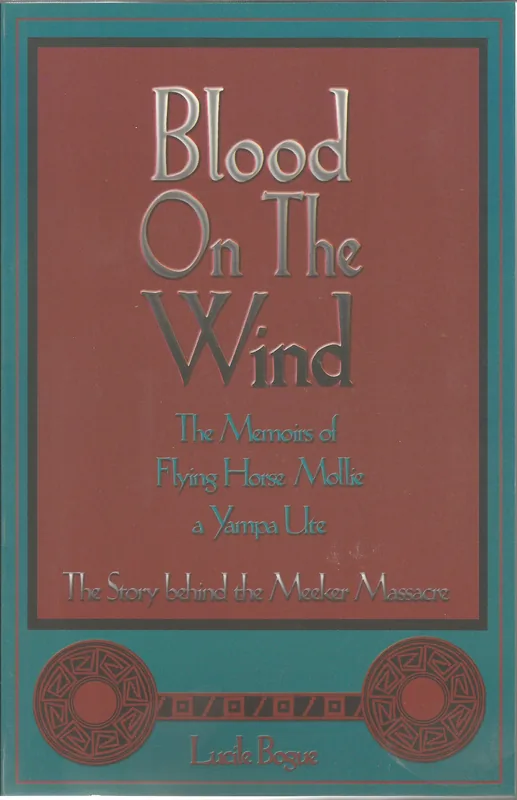
Blood on the Wind
by Lucile Bogue
Just as the reader falls into step with the rhythm of Mollie’s life, with its sense of community and nature-embracing customs, all is tossed on the winds of change. As easterners increase their demand for land, government leaders such as Colorado Governor Frederick Pitkin, with the help of Denver Post editor William B. Vickers, instigate a political campaign with one agenda, “The Utes Must Go!”
- ISBN
- 1-890437-05-0
- Pages
- 123
- Place
- Colorado
- Listed at
- $10.74
The price shown is the last one on record and is historic, not a current offer.
- Direct from us info@westernreflectionspublishing.com or (336) 565-6915. We pack and post from Lake City.
- Amazon Buy from Amazon.
- Any bookshop Quote ISBN 1-890437-05-0 and your local bookseller can order it.
About this book
Blood on the Wind is built around a woman named Mollie and the rhythm of her life. The description says the reader falls into step with it, with its sense of community and its customs that embrace nature, until everything is tossed on the winds of change.
That change is political. The description says easterners increased their demand for land, and that government leaders such as Colorado Governor Frederick Pitkin, helped by Denver Post editor William B. Vickers, set off a campaign with a single aim: "The Utes Must Go!" The book is set in the years when Colorado's Ute people were pushed off their homeland.
Lucile Bogue is the author. The record we hold for this book is limited, so we do not add anything beyond the description above.
Who it is for
Blood on the Wind is for readers of Colorado history who want to see the removal of the Utes through the eyes of one person rather than through treaties and dates. People interested in Ute history, the western slope of Colorado, and the politics behind the land grab will find the governor and the newspaper editor named in the description.
The place and the period
The governor's slogan was real. Wikipedia's account of the Meeker Massacre says Frederick Walker Pitkin, the recently elected governor of Colorado, had campaigned on a theme of "The Utes Must Go!" It adds that the governor, other local politicians and settlers made exaggerated claims against the Utes in their efforts to evict them.
The same account says a Ute reservation covering most of western Colorado had been granted by treaty in 1868. During the 1870s miners moved onto it, and the government made little effort to stop them. On September 29, 1879, Utes attacked the White River Indian agency and killed the agent, Nathan Meeker, and ten male employees. The conflict ended with the Utes losing most of their Colorado reservation lands.
The Ute Agreement of 1880 was signed on March 6 of that year in Washington, D.C., according to the Wikipedia article on the Ute people, and an 1882 act took the lands the Utes had occupied in Colorado.
Source: Wikipedia, Meeker Massacre
Ways to use this book
Reading the slogan against the record
If the campaign in the book's description is new to you, read the Meeker Incident article beside the book. It notes the event is still often called a massacre, though some now prefer incident. Seeing both terms helps when you compare accounts.
Planning a visit to Ute country
The Ute Indian Museum in Montrose suits a reader who wants to see the region after the story. Check History Colorado's page for current hours and admission before you drive.
Comparing with other Colorado history
Browse the library's history category for books on the same decades, then read them alongside this one to see how different authors treat the 1870s.
Go deeper
Blood on the Wind is set in the years when Colorado's Ute people lost their homeland. These three resources cover the museum, the 1879 conflict and the treaty that came before it, so a reader can set the story against the record.
Ute Indian Museum
A History Colorado museum in Montrose, built in 1956 near the ranch of Uncompahgre leader Chief Ouray and his wife Chipeta.
Meeker Incident
The Colorado Encyclopedia's account of the events of September 29 to October 5, 1879 at the White River Indian Agency, which it calls the catalyst for the Utes' expulsion from Colorado.
Colorado Encyclopedia: Meeker Incident → (opens in a new tab)
Ute Treaty of 1868
An article on the treaty that created a large reservation on the Western Slope. It explains why the same agreement opened the Rockies to development and became a step toward the Utes' removal.
Colorado Encyclopedia: Ute Treaty of 1868 → (opens in a new tab)
Good to know
Who is Mollie?
What political campaign does the book describe?
When was it published?


Have a book of your own?
This is the kind of book the house publishes: regional history, biography, memoir and the stories that belong to a place. Send us yours and a person will read it.