
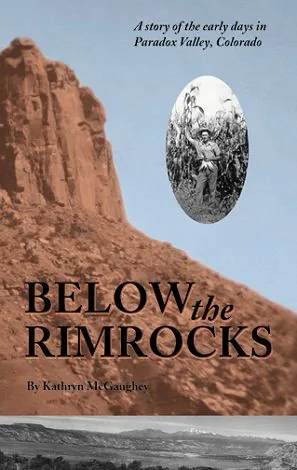
Below the Rimrocks
Kathryn McGaughey's account of the Paradox Valley and its surrounding area includes much of the history and lore of this unique place and its river that defies the geologic norm by running across and not along the valley floor. Her story is one that spans from Native American inhabitants, exploration and pioneers to early twentieth-century "plain folk" and how they coped with a harsh lifestyle, murderous villains, overbearing land holders, cattle rustlers and more. This is a fascinating tale of "life below the rimrocks."
- Published
- 2003
- ISBN
- 1-890437-92-1
- Pages
- 143
- Category
- History
- Publisher
- Western Reflections Publishing Co.
- Listed at
- $13.97
Publication details from Open Library. The price shown is the last one on record and is historic, not a current offer.
- Direct from us info@westernreflectionspublishing.com or (336) 565-6915. We pack and post from Lake City.
- Amazon Buy from Amazon.
- Any bookshop Quote ISBN 1-890437-92-1 and your local bookseller can order it.
About this book
Below the Rimrocks is Kathryn McGaughey's account of Paradox Valley and the country around it. According to our description, it holds much of the history and lore of this unusual place and of its river, which breaks the geologic norm by running across the valley floor instead of along it. The story starts with the Native American people who lived there, then moves through exploration and the pioneers who followed.
From there the book turns to what our description calls the early twentieth century's plain folk, and how they coped with a harsh way of life. The same description lists murderous villains, overbearing land holders and cattle rustlers among the hazards they faced. It closes by calling the whole thing a tale of life below the rimrocks.
Paradox Valley sits in western Montrose County, Colorado, near the Utah border. Wikipedia says it runs about 25 miles northwest to southeast and 3 to 5 miles wide, and that the Dolores River enters through a gap in one wall, crosses the floor and leaves through a gap in the opposite wall. It adds that squatters began grazing cattle there in 1877, that the Utes were pushed out by 1881, and that Congress opened the land to settlement in 1882. Our catalogue lists the book under History and frontier and pioneer life.
Who it is for
This book speaks to readers of Paradox Valley and western Colorado frontier history.
Ways to use this book
Visiting the valley
Read the Birding Trail page before you drive in. It gives directions from Bedrock and says the ponds are viewable only from the road, so plan stops with that in mind.
Tracing a ranch family
If your people ran cattle or sheep near the Dolores, contact the Montrose museum and the Mesa archives with surnames and years. Find out what each holds before you book a trip.
Go deeper
Paradox Valley lies in western Montrose County, with the Dolores River crossing its floor. These resources cover the river, the valley's wildlife and the county's history, so you can read the book and see the country too.
Dolores River SRMA, Bureau of Land Management
The agency describes a 102 mile stretch of river through broad valleys and canyons, with whitewater from flatwater to Class IV and named access points. Check the page for current conditions.
Paradox Valley, Colorado Birding Trail
Explains why settlers named the valley Paradox and lists birds and other wildlife seen on its sagebrush floor. It also notes that the farm ponds are on private property.
Montrose County Historical Museum
The county historical society's site for its museum in Montrose, the county that holds Paradox Valley. Ask there about local families and homesteads.
Archives and Special Collections, Colorado Mesa University
Collects materials on the history of western Colorado, including manuscripts, rare books and digital content. Its page says appointments are preferred.
Good to know
What place does the book cover?
Is it fiction or nonfiction?
What period does it span?
Where can I buy it?


Have a book of your own?
This is the kind of book the house publishes: regional history, biography, memoir and the stories that belong to a place. Send us yours and a person will read it.