
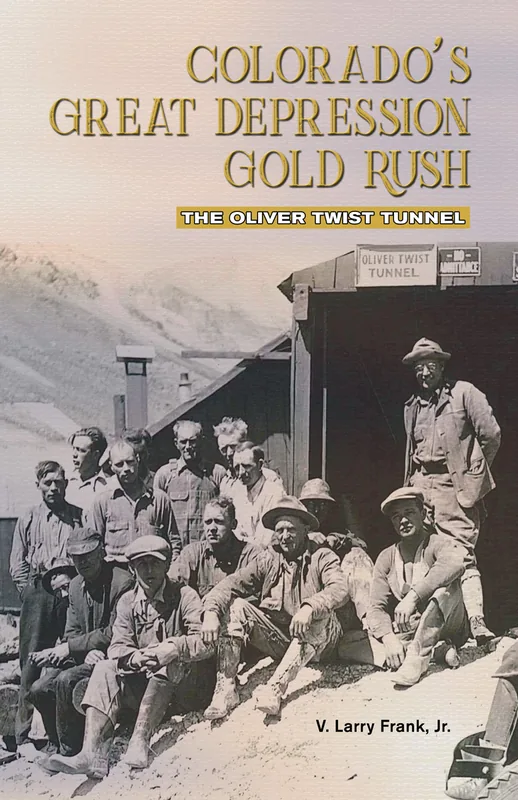
Colorado's Great Depression Gold Rush
The year was 1931. The Great Depression was settling in for a prolonged stay while Leadville’s mining district struggled to stay afloat. A few courageous local investors saw a ray of hope in the old gold mines high atop Mosquito Pass, and bet that they could make the old workings pay. George and Robert Elder were two of those investors, and this is the story of their role in Colorado’s Great Depression gold rush. The father and son team put their savings and their sweat into the London Mountain Gold Mining Company, working devotedly to coax a bonanza from the old Oliver Twist Tunnel. They, and the men who worked for them, endured violence, bank closures, mine accidents, and the forbidding conditions of 13,185-foot-high Mosquito Pass. Robert Elder’s original photographs bring the story of a small, hard-working mining company in the Great Depression to life.
- Published
- 2017
- Place
- Leadville
- Listed at
- $16.95
Publication details from Open Library. The price shown is the last one on record and is historic, not a current offer.
- Direct from us info@westernreflectionspublishing.com or (336) 565-6915. We pack and post from Lake City.
- Amazon Search Amazon for this book. Out of print books usually turn up through marketplace sellers.
About this book
Colorado's Great Depression Gold Rush is the story of one mining venture in the 1930s. The record describes investors who saw a ray of hope in the old gold mines high on Mosquito Pass and bet that they could make the old workings pay. George Elder and his son Robert were two of those investors. Retail listings give the full title as Colorado's Great Depression Gold Rush: The Oliver Twist Tunnel, and the tunnel is the center of the book.
A Grand Junction Sentinel columnist who read it says the tunnel was owned and operated by the London Mountain Gold Mining Co. during the Depression, and calls the story one of so much potential and so many setbacks. The book is organized by year. It has six chapters, one for each year from 1931 to 1936, and each opens with a timeline of important events.
The same reviewer notes that the book also carries more than a hundred photographs. Author V. Larry Frank Jr. wanted a human-interest story as well as a mining story, so the people who worked at the tunnel and the places they came from share the pages with the ore and the weather.
What is inside
The old gold workings
Investors in the 1930s look at the old mines high on Mosquito Pass and try to make them pay.
The Elders
George Elder and his son Robert are two of the men who bet on the old workings.
One chapter per year
Six chapters cover 1931 to 1936, each opening with a timeline of important events.
The people on the payroll
Each chapter closes with a list of the tunnel's employees for that year, plus biographies of the major players.
Photographs
More than a hundred photographs help show the mine and the times.
Getting a mine started
The reviewer describes the work before any ore moved: a leased mine, a new company, roads, buildings and a supply of food and equipment.
Who it is for
This book suits readers of Colorado mining history who want to see one operation from the first lease to the last shipment. People who know Leadville, Alma and the Mosquito Pass country will find a stretch of that ground in the 1930s, a decade usually discussed in terms of closures rather than new mining. It also fits anyone interested in Depression-era business, since the story includes stock sales, a corporate office in Denver and money that kept running short.
About the author
V. Larry Frank Jr. is described in a Grand Junction Sentinel column as a man who never thought of himself as a writer. In 1991 he was working as a historian in Leadville, where he met mining engineer and historian Bob Elder. Elder later handed over ledgers, stock books, photographs and letters, and Frank began the book in 2015. It was published in 2017. His author page has the details we hold.
The place and the period
The Sentinel column explains why the venture looked sensible. The Gold Standard Act allowed President Franklin D. Roosevelt to edge up the price of gold slowly, which raised the value of a mine. Work was abundant at the Twist even though a quarter of the nation was unemployed, and the London Mountain Gold Mining Co. was in position to join the Alma District's three most successful gold mining companies. The Elder family prepared for a million-dollar-a-year operation.
Then the setbacks arrived. Banks were failing and cash was hard to come by. The weather at 12,000 feet caused problems all the time, and the first shipments of gold assayed far below what was expected. Expenses and the work force were cut. Elder's grandfather used most of his life's savings and his wife's inheritance to build a mill at the mine site. The whole venture ended in 1936, when the high-grade ore was never found.
Good to know
What is the Oliver Twist Tunnel?
Which years does the book cover?
Does it have photographs?
Where can I buy it?


Have a book of your own?
This is the kind of book the house publishes: regional history, biography, memoir and the stories that belong to a place. Send us yours and a person will read it.