





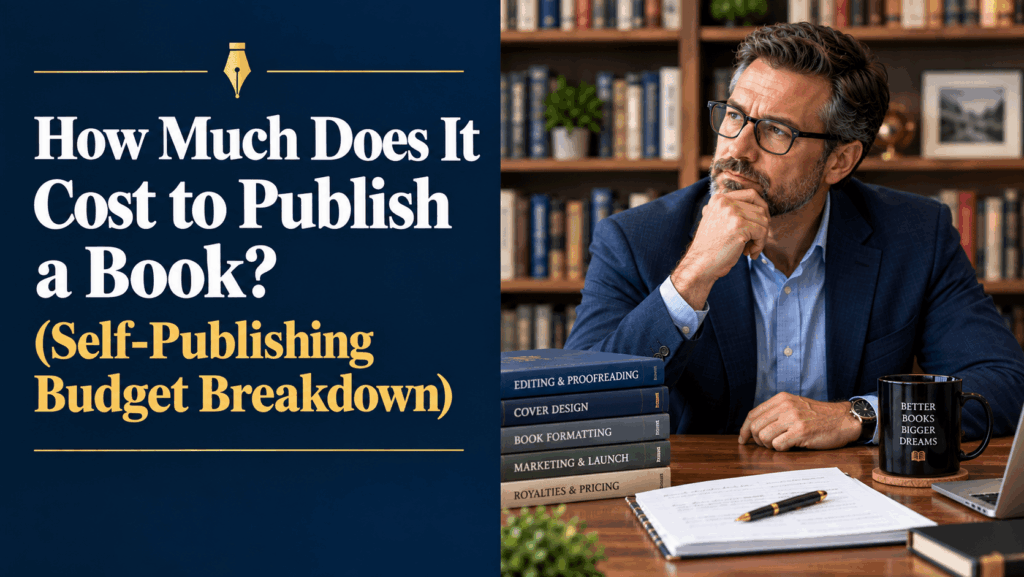
Here’s the real number: a quality self-published book runs somewhere between $500 and $5,000, with most authors landing between $2,000 and $4,000 once editing, cover design, formatting, and a basic launch are covered. TrTraditional publishingas almost no upfront cost, but that “free” comes with real trade-offs in royalties, control, and time. Below is the full breakdown, category by category, so you can see exactly where that money goes and decide where you actually want to spend it.
Self-Publishing vs. Traditional vs. Hybrid: The Cost Trade-Off
Before the line items, it helps to see the three paths side by side, since “which is cheaper” isn’t quite the right question.
Traditional publishing costs you close to nothing upfront. The publisher covers editing, design, printing, and distribution. In exchange, you typically earn 5 to 25 percent in royalties, give up meaningful creative control over your own cover and edits, and wait, often well over a year, for a publisher to accept your manuscript and get it to shelves.
Self-publishing puts the upfront cost on you, generally $500 to $5,000-plus, but you keep full creative control and typically earn 35 to 70 percent in royalties depending on the platform. You’re also the one managing every vendor decision along the way.
Hybrid publishing sits in between. You pay $4,000 to $50,000 upfront, similar to self-publishing, but a hybrid publisher’s in-house team handles production and distribution for you, and you receive a higher royalty rate than traditional publishing in return.
None of these is objectively the cheap option. Each one moves the cost somewhere different: upfront cash, long-term royalties, creative control, or your own time.
Editing Costs
Editing is not one expense, it’s several, and treating it as a single line item is how authors end up either overpaying or skipping a stage they actually needed. Using current Editorial Freelancers Association rate data for a representative 60,000-word manuscript:
- Developmental editing: $2,400 to $4,800
- Line editing: $1,500 to $3,500
- Copy editing: $1,200 to $2,400
- Proofreading: $700 to $1,200
These stages are often bundled at a discount if you hire the same editor for multiple passes. The mistake to watch for: skipping the developmental edit to save money. A clean copy edit on a structurally weak manuscript just means the structural problems get printed with better punctuation. If you’re still sorting out whether your project needs an editor, a ghostwriter, or both, this breakdown walks through the difference in more detail.
Cover Design Costs
Expect to spend anywhere from $175 for a template-based or marketplace design up to $2,000 or more for an established designer with a proven track record in your genre. This is not the category to cut corners on. A cover’s job is to get a browsing reader to click, and a flat, amateur-looking cover undercuts every other dollar you spend on the book itself.
Formatting and Interior Layout Costs
Straightforward formatting for a standard fiction or nonfiction manuscript typically runs $200 to $600. Books with heavy graphics, tables, or illustrations cost more, since every element has to be placed and checked across both print and digital formats. If your budget is genuinely tight, free tools like Reedsy’s bobook editorr Amazon’s Kindle Create can produce a passable result, though they won’t match a paid formatter’s polish on a complex layout.
ISBN and Copyright Registration
An ISBN costs $125 for a single number or $295 for a block of ten through Bowker, the official US ISBN agency. Buying a block of ten is the better deal if you plan to write more than one book. You can technically get a free identifier from Amazon or IngramSpark instead, but your book will be listed under their name as publisher rather than yours. Copyright registration through the U.S. Copyright Office is optional but inexpensive, and it adds a real layer of legal protection worth having before wide publication.
Printing Costs: Print-on-Demand vs. Bulk Offset
Print-on-demand through Amazon KDP or IngramSpark runs roughly $3 to $5 per copy for a standard paperback, with no upfront cost since books print only as they sell. Bulk offset printing drops the per-copy cost to $1 to $3, but requires ordering 500 or more copies upfront. Unless you already know you have that kind of demand lined up, print-on-demand is the safer starting point.
Audiobook Production Costs
If you record it yourself, basic equipment runs $500 to $2,000 as a one-time setup cost. Hiring a professional narrator typically costs $100 to $500 per finished hour, so a full-length audiobook usually lands between $300 and $1,500 depending on the book’s length and the narrator’s experience. Fiction with multiple voiced characters tends to run higher than straightforward nonfiction narration.
Marketing and Launch Costs
This is the category authors most often underbudget, and then overspend on in a panic once the book is live. A sensible starting launch budget runs $200 to $1,000: a few book promotion site listings, a modest ad budget on Amazon or social platforms, and possibly an author website. The most common way authors waste marketing money is spending heavily on ads before the book has any reviews or sales data to optimize against. Start small, see what actually converts, then scale up.
Beyond the initial launch, ongoing marketing is really a separate, recurring budget rather than a one-time cost. An email marketing tool runs anywhere from free (for a small list) to $50 or more a month as your subscriber count grows. Paid advertising on Amazon or social platforms only makes sense once you have a baseline of reviews and can measure what a click is actually worth to you in sales. Authors who treat marketing as a single launch-week expense are usually the ones surprised, months later, by how quickly momentum fades without any ongoing spend behind it.
Hidden Costs Authors Forget to Budget For
A few smaller expenses rarely make it into the headline number, and they add up faster than most authors expect. Author copies (the physical books you’ll want on hand for events, gifts, or your own shelf) cost per-unit printing fees even though you’re not selling them. If you’re pursuing book awards or contests to build credibility, entry fees typically run $50 to $100 per submission, and serious contenders often enter several. If you’re forming a business entity around your publishing activity, which many self-published authors eventually do for tax purposes, expect modest state filing fees on top of everything above. None of these are large individually, but a realistic budget should have a small buffer, $200 to $400, set aside for exactly this kind of expense that doesn’t fit neatly into editing, design, or marketing.
Sample Budget: Three Realistic Tiers
Rather than one misleading average, here’s what three real budget levels actually look like in practice.
| Tier | What’s included | Typical total |
|---|---|---|
| Lean | Copy edit and proofread only, template cover, DIY formatting, free ISBN or ASIN | $800 to $1,500 |
| Standard | Full editing pass, custom cover, professional formatting, purchased ISBN, modest launch budget | $2,500 to $4,500 |
| Premium | Full editing suite, premium cover design, audiobook, broader marketing launch | $6,000 to $10,000+ |
Most first-time authors land somewhere in the Standard tier, and it’s a reasonable place to aim if you’re not sure yet.
Traditional Publishing: What “Free” Actually Costs You
It’s worth revisiting traditional publishing honestly rather than dismissing it. There’s no upfront production cost, true, but the real costs show up elsewhere: lower royalty rates over the life of the book, reduced say over your own cover and edits, giving up certain rights to the publisher, and a submission-to-shelf timeline that can stretch past a year once you account for querying agents and waiting for a publishing slot. For the right project and the right author, that trade is worth making. It’s just not the cost-free option it’s sometimes made out to be.
Is It Worth Paying Someone to Coordinate All of This?
Here’s the honest question worth asking after reading nine categories of cost and roughly a dozen separate vendor decisions: do you actually want to personally manage an editor, a cover designer, a formatter, and a launch plan as four or five separate hires, each with their own timeline, their own revision rounds, and their own back-and-forth over email?
Think about what that actually looks like in practice. You’d be vetting and hiring an editor, waiting several weeks for a developmental pass, incorporating those notes, then hiring a separate copy editor once the structure is settled, then finding a cover designer and going through two or three rounds of concepts, then a formatter to bring it all together, then figuring out ISBN registration and platform setup, then building a launch plan from scratch with no prior experience running one. Each step is manageable on its own. Managing all of them in sequence, on top of a full-time job or a business you’re already running, is where most self-published projects quietly stall for months between “manuscript done” and “actually published.”
For some authors, doing it themselves is genuinely the right call, and the Lean or Standard tier above is a good fit for that. For others, the answer is no, and that’s a completely legitimate reason to work with a publishing service that packages and coordinates these pieces for you. It costs more than assembling every vendor individually, but it removes the project-management burden entirely, and for a first book especially, that trade is often worth it.
How to Avoid Overpaying Without Cutting Corners
A few practical rules that protect your budget without sacrificing quality: get at least two quotes for any editing or design service before committing, ask to see a sample edit or a cover mockup before signing on for a full project, and never skip the developmental edit on a nonfiction book to save a few hundred dollars. The corners that feel cheapest to cut in the moment are almost always the ones that cost you the most in lost sales later.
It’s also worth being skeptical of quotes that sit far outside the ranges above in either direction. A developmental edit quoted at $300 for a 70,000-word manuscript is not a bargain, it’s a sign the work won’t be thorough. On the other end, a cover designer quoting $5,000 for a standard genre cover isn’t automatically better than one quoting $600, and price alone tells you very little about fit. Ask to see samples in your specific genre before you ask about price at all.
The Bottom Line
Most quality self-published books cost $2,000 to $4,000 once you account for editing, design, formatting, and a basic launch. The real decision underneath that number isn’t just how much to spend, it’s whether you want to assemble and manage every vendor yourself for less money, or hand the coordination to someone else for more money and far less legwork. If you want a specific number for your own project rather than a range, get a free consultation and we’ll walk through it together. And if you haven’t written the manuscript yet, our ghostwriting services and full pricing guide cover that side of the budget too.
