





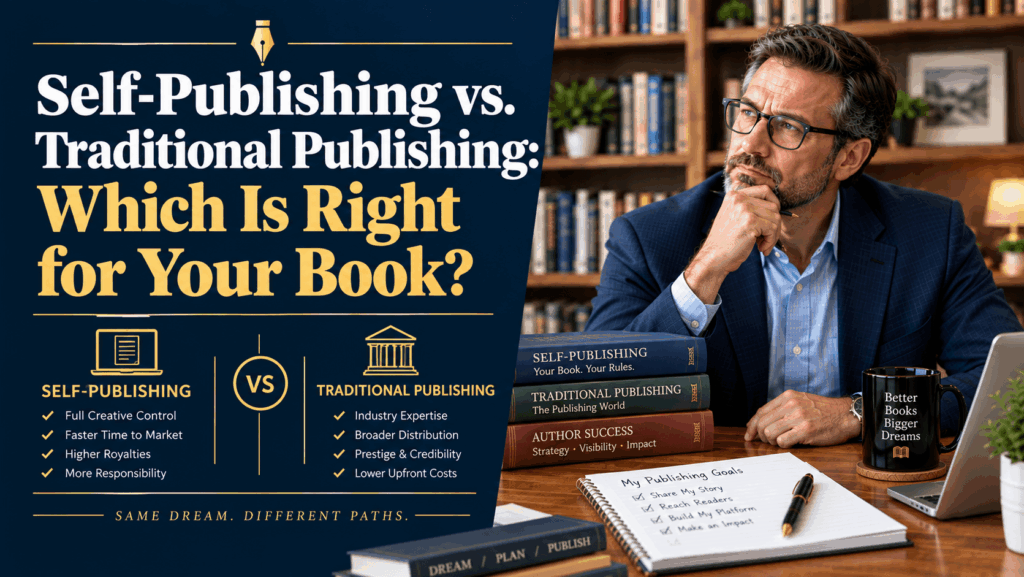
Ask this question online and you will get two confident answers. One camp will tell you that traditional publishing is a dying gatekeeping racket that takes your rights and pays you almost nothing. The other will tell you that self-publishing is vanity dressed up, and that a real book has a publisher behind it. Both camps are loud, and both are wrong, because the honest answer depends entirely on what your book is and what you want it to do.
One thing worth saying up front, since most articles on this subject do not: we provide self-publishing support, which means we have a commercial interest in your answer. We are going to tell you anyway when traditional publishing is the better choice, because for some books it clearly is, and you would find out eventually.
This guide covers how each route actually works, the five differences that genuinely matter, what hybrid publishing is, how to avoid the companies that prey on new authors, and how to decide based on what your book is for.
Self-Publishing vs. Traditional Publishing at a Glance
Traditional publishing means a publisher takes on the cost and risk of producing and distributing your book, in exchange for the rights and most of the revenue. Self-publishing means you take on the cost and the work, and you keep the rights and a much larger share of each sale.
| Factor | Traditional publishing | Self-publishing |
|---|---|---|
| Upfront cost to you | None; the publisher pays | You pay for editing, design, and production |
| Advance | Common, though often modest | None |
| Royalty rate | Roughly 10% to 15% of list price | Roughly 35% to 70% ebook, 40% to 60% print |
| Time to publication | Often around two years after signing | As fast as two to three months |
| Gatekeeping | Agent and publisher must both say yes | None; you decide |
| Creative control | Shared, and sometimes limited | Entirely yours |
| Rights | Publisher acquires some or all | You keep everything |
| Bookstore distribution | Far easier, though never guaranteed | Difficult at national scale |
| Marketing | Some support, but you still do much of it | Entirely yours |
Figures are current industry ranges rather than fixed terms, and they vary by publisher, genre, and format.
The trade is reasonably clean once you see it. Traditional publishing gives you validation, distribution, and no financial risk, and takes control and most of the money. Self-publishing gives you speed, control, and a far larger share of each sale, and asks you to fund and manage the whole thing.
How Traditional Publishing Actually Works
The sequence matters, because most of the time cost is in stages people forget about.
You finish the manuscript, or for nonfiction, a proposal with sample chapters. You then query literary agents, which is its own extended process with a low success rate. If an agent signs you, they submit your book to publishers. If a publisher acquires it, contracts are negotiated, and only then does the editorial process begin, followed by production, and finally a release date that has been slotted into the publisher’s catalogue.
From signed contract to bookshelf is commonly around two years, with nonfiction typically slower than fiction. That is on top of however long querying took.
The advance is the piece most first-time authors misunderstand. It is not a fee, it is money paid in advance against your future royalties. If your advance is $5,000, you receive no further royalty payments until the book has earned $5,000 in net receipts. Failing to earn out can also affect your chances of a second deal, sometimes even with a different publisher. Advances for new authors are often more modest than people imagine, commonly in the low thousands from smaller presses.
How Self-Publishing Actually Works
The parallel sequence is shorter and entirely under your control. You finish the manuscript, have it professionally edited, commission a cover and interior layout, register an ISBN, set up distribution through print-on-demand and ebook platforms, and launch when you are ready.
The persistent myth is that self-publishing means doing everything yourself. Almost nobody successful does. Independent authors hire the same categories of specialist a publisher would assign, they simply hire them directly and choose who to work with. That is a meaningful difference in control, and it is also the reason quality varies so much across self-published books: the author decides how much professional help to buy.
Be realistic about cost. Editing is usually the largest line item, followed by cover design and formatting. Publishing to a genuinely professional standard typically runs into the low thousands, and skipping the editing to save money is the most common and most damaging false economy in the field. Our professional editing and self-publishing services cover those stages if you want them handled.
The Five Differences That Actually Matter
1. Money, in both directions
Traditional publishing pays you before publication and costs you nothing, but your share of each sale is small, usually 10% to 15% of list price, and you see none of it until the advance earns out. Self-publishing costs money before it earns any, then pays several times more per copy.
Which comes out ahead depends almost entirely on volume, and the uncomfortable truth is that most books in both categories sell modestly. A book that sells 500 copies makes very little either way. The financial case for self-publishing improves the more copies you sell and the more directly you can reach your readers.
2. Control
With a publisher, the cover, title, edits, and publication date are shared decisions, and sometimes not yours at all. When you self-publish, every one of those is yours.
In fairness to publishers, their input is often genuinely valuable. Cover and title decisions are informed by sales data across hundreds of titles, which an individual author does not have. Plenty of authors have been talked out of a title they loved and were later grateful. Control is not automatically an advantage if you have no market knowledge to apply.
3. Time
Roughly two years versus roughly two to three months, and the gap is structural rather than a sign of inefficiency. Publishers work through acquisition boards, editorial cycles, and catalogue scheduling, and your book has to fit a marketing calendar shared with everything else on their list. If your book is tied to a moment, a campaign, or a business launch, that delay is not a minor inconvenience. It can make the book pointless.
4. Distribution and credibility
This is traditional publishing’s real advantage and it deserves to be stated plainly rather than minimized.
Getting a self-published book into bookstores at national scale is very difficult. Bookstores buy through publishers with sales teams and return policies, and some decline to stock or host events for self-published titles as a matter of policy. Local and independent shops are far more approachable, and plenty of indie authors build regional placement one conversation at a time, but that is a different thing from national distribution.
Traditional publication also still carries a validation signal in specific contexts: academic settings, major review coverage, and many literary awards. Writer’s Digest’s rundown of the pros and cons of each route covers the bookstore dynamic well, though note it dates from 2021, so treat its structural points as more durable than its figures.
5. Marketing
Here is the expectation that catches nearly every first-time author. A traditional deal does not mean someone else markets your book.
Publishers provide some support, weighted heavily toward their lead titles, and authors are expected to carry a great deal of the promotion themselves regardless of route. A novelist’s account of publishing both ways describes exactly this: even with a supportive publisher, she was still writing her own newsletters, running her own social media, and representing the book herself. If you are hoping a publisher will handle marketing so you do not have to, that is not what a contract buys.
What About Hybrid Publishing?
There is a third model, and it is worth understanding because the term gets abused.
A legitimate hybrid publisher selects the titles it takes on, the author contributes to production costs, and in return the author receives higher royalties than a traditional deal along with more support than going it alone. Done properly it is a real option, particularly for nonfiction authors who want production handled but do not want to spend two years querying.
The caution is simple and important. A genuine hybrid publisher is selective and completely transparent about costs, rights, and what you receive. Any company that accepts every submission and charges for the privilege is not a hybrid publisher. It is a vanity press using a friendlier word, which brings us to the section every first-time author should read.
How to Spot a Vanity Press
We sell publishing services, so this is us warning you about bad actors in our own category. It matters more than anything else in this article, because these companies target exactly the people reading it.
The distinction is straightforward. When you hire a legitimate service provider, you are buying specific, defined professional work: editing, cover design, formatting, production. You know what each service is, you know what it costs, and you keep your rights and your royalties. A vanity press instead presents itself as a publisher that has selected your book on merit, then charges you thousands for the privilege, typically delivering mediocre work and distribution that amounts to little more than listing your title with wholesalers.
The warning signs are consistent:
- They approached you, often with unsolicited praise for a manuscript they have barely read.
- They frame payment as selection. Any variation of “we loved your book, here is the invoice” is the core move.
- The deliverables are vague. You cannot get a clear list of what you receive for what price.
- They want rights. A service provider has no reason to hold any claim on your copyright.
- Royalty terms are murky, or based on figures you cannot verify.
- There is time pressure, usually a discount expiring soon.
- They promise outcomes nobody can promise, including bestseller status, bookstore placement, or media coverage.
Here is a clean test you can apply to any company, including us. Ask them exactly what you get, exactly what it costs, and ask them to confirm in writing that you retain all rights to your book. A legitimate provider will answer all three plainly and immediately. If any answer is evasive, walk away and do not feel rude about it.
Which Route Is Right for Your Book?
Rather than another pros and cons list, work from what the book is actually for.
If the book exists to build a business
Self-publishing usually wins, and not marginally. Speed matters because the book supports something happening now. Control matters because the book has to align with your positioning. You can buy your own copies at cost for clients and events, which is often where most of the distribution happens anyway. And national bookstore placement, traditional publishing’s genuine advantage, is close to irrelevant when the book functions as a credibility asset rather than a retail product. Our guide to writing a business book covers what makes that kind of book work.
If it is a memoir for family and legacy
Self-publishing, almost without exception. You know exactly who the readers are, the timeline is personal rather than commercial, and no publisher is needed to reach the people who matter. Traditional publishers also acquire very few memoirs from authors without an existing public profile, so the querying route is likely to be a long disappointment.
If it is a debut novel and you want a writing career
Try traditional publishing first. We say that as a company that would happily take your money to self-publish it.
Advances, editorial development, national bookstore reach, professional review coverage, and eligibility for most major literary awards all still favour the traditional route for fiction, and a first novel is the point at which those things compound into a career. Querying is slow and the rejection rate is high, but you can always self-publish afterwards. It is much harder to go the other way with the same book.
If speed or control is non-negotiable
Self-publishing, and there is not much to debate. No traditional publisher can move at that pace, and none will hand over final say.
Whichever route you take, one requirement does not change: you need a finished manuscript that is genuinely good. Publishers reject weak books and readers abandon them, so the writing is the part you cannot route around.
Deciding on Your Path
There is no universally correct answer here, only the answer that fits this book, this author, and this goal. Treat the evangelism on both sides as noise rather than information, and ask instead what you want the book to accomplish and what you are willing to trade to get it. A former literary agent’s guide to choosing between them makes the same point from the other side of the industry, and it is worth reading before you commit.
If the manuscript is the thing standing between you and either route, that is what our ghostwriting services exist for, and it applies equally whether you end up querying agents or publishing independently. If you would like to talk it throughbefore deciding anything, we are glad to help you work out which path fits, including if the answer is one we do not sell.
