





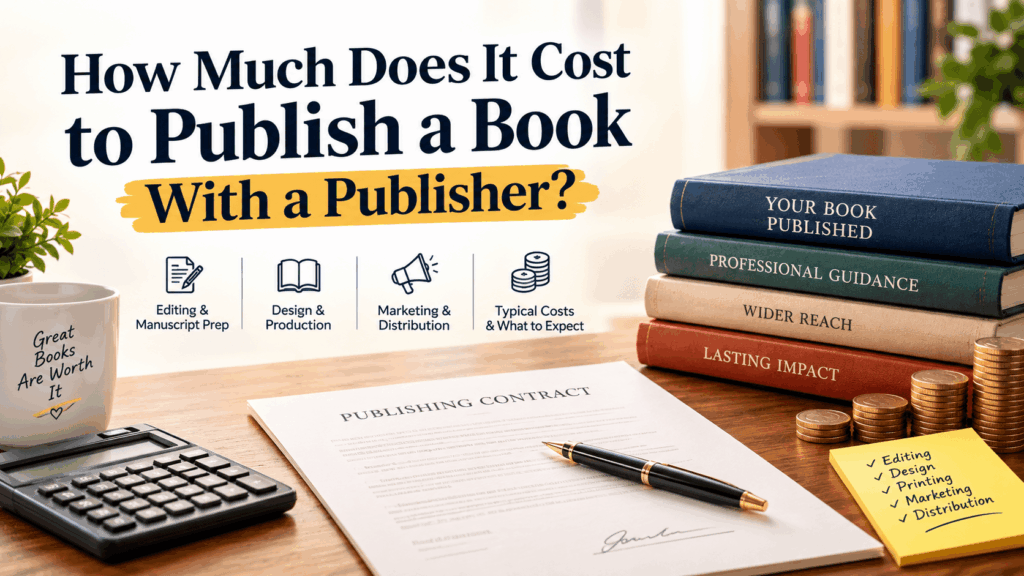
Publishing a book is a goal that many writers carry for years, and one of the first practical questions they ask is simple: how much does it cost to publish a book with a publisher? The honest answer is that there is no single price tag. What you pay, or whether you pay anything at all, depends on the type of publisher you sign with, the publishing model behind the contract, and how much creative and financial control you want to keep. A traditional deal can cost you nothing out of pocket, while a hybrid package can run several thousand dollars, and a vanity press can quietly drain far more than the book is worth.
This guide breaks down the real numbers behind each publishing route, explains what a legitimate publisher should and should not charge you, and helps you decide which path fits your budget and your goals. By the end, you will know exactly where your money goes and how to spot a bad deal before you sign it.
What “Publishing With a Publisher” Actually Means
Before we talk dollars, it helps to define the term. “Publishing with a publisher” can describe three very different arrangements, and each one carries a completely different cost structure. Grouping them together is where most confusion, and most overspending, begins.
- Traditional publishing: A publishing house buys the rights to your manuscript, pays for production, and pays you royalties. You pay nothing.
- Hybrid publishing: You and the publisher share the investment. You pay for services and, in return, keep higher royalties and more control.
- Vanity publishing: You pay all of the costs, often inflated, while the “publisher” provides little real value.
Understanding which model you are actually dealing with is the single most important step in protecting your money. A company can call itself a “publisher” and still expect you to fund everything, so the label alone tells you very little.
Traditional Publishing: What It Costs the Author
Traditional publishing is still viewed by many writers as the gold standard. A recognized house acquires your book, invests in its production and distribution, and pays you a share of every sale. It is competitive and slow, but the financial arrangement is clear.
Does Traditional Publishing Cost the Author Anything?
In legitimate traditional publishing, the author pays nothing upfront. The publisher absorbs the financial risk and covers the major expenses, which usually include:
- Developmental editing, copyediting, and proofreading
- Book cover and interior design
- ISBN registration and cataloging
- Printing, warehousing, and distribution
- Baseline marketing, catalog placement, and publicity
In exchange, the publisher pays royalties, typically 5% to 15% of the list price for print books and 20% to 25% for ebooks. Many authors also receive an advance, which is money paid before publication and later “earned back” through sales. If the book never earns out the advance, you almost never have to repay the difference, so a well negotiated advance is guaranteed income.
How Big Are Advances Today?
Advances vary widely, and headline six-figure deals represent well under 1% of the market. For most debut authors in 2026, advances land between $5,000 and $15,000. A first novel sold to a Big Five house often falls in the $10,000 to $25,000 range, while smaller independent presses tend to pay less. It is also increasingly rare to receive the full sum on signing. Payments are usually split across milestones such as contract signing, manuscript delivery, and publication. For a clear walkthrough of how these payments work, Writer’s Digest offers a plain-language explanation of advances and royalties.
The Indirect Costs Authors Still Face
Even with a zero-fee deal, traditional publishing is not entirely free. Authors often spend money on:
- Professional editing before submission, so the manuscript competes well with an agent’s slush pile
- Travel for events, signings, or book tours
- A personal author website, email list, and social media tools
- Optional advertising to support the launch
These costs are optional, but many authors treat pre-submission editing as a smart investment because a polished manuscript is far more likely to earn a contract. If you want your pages agent-ready, our professional book editing services can strengthen the manuscript before you query.
Literary Agents and Their Commissions
Most major publishers do not read unsolicited manuscripts, so getting through the door usually means signing with a literary agent first. The good news is that reputable agents cost you nothing upfront.
How Do Literary Agents Get Paid?
A legitimate agent never charges reading fees or upfront retainers. Instead, they earn a commission only when you get paid, which keeps their goals aligned with yours. Standard rates are:
- 15% on domestic book sales
- 20% to 25% on foreign rights and film or television deals
If an “agent” asks for money before selling your book, treat it as a warning sign. In real trade publishing, the agent invests time upfront and profits only when your book sells.
Hybrid Publishing: Shared Costs, Shared Control
Hybrid publishing sits between the traditional and self-publishing worlds. You contribute financially, and in return you keep more rights, earn higher royalties, and often reach print far faster than the traditional timeline allows.
Typical Costs of Hybrid Publishing
Hybrid packages in 2026 generally run from $5,000 to $25,000, and full-service programs that include ghostwriting can climb past $40,000. A mid-range package usually bundles:
- Professional editing across multiple stages
- Custom cover and interior design
- ISBN assignment and retail distribution setup
- Marketing strategy and launch support
Because you fund production, hybrid publishers typically pay much higher royalties, often 40% to 70%, and give you a real say in creative decisions. The key is confirming exactly what each dollar buys, since quality varies enormously between companies.
Who Is Hybrid Publishing Right For?
Hybrid publishing tends to suit authors who:
- Want professional production without doing everything themselves
- Have the budget to invest upfront
- Value creative control and higher royalties
- Write for a defined niche, such as business, memoir, or self-help
If a done-for-you approach appeals to you, our full book publishing services manage editing, design, and distribution under one roof so nothing slips through the cracks.
Vanity Publishing: High Fees, Low Value
Vanity publishing is the model most likely to cost you money you should never have spent, and it is frequently disguised as hybrid publishing.
What Is Vanity Publishing?
A vanity press charges large upfront fees, often $5,000 to $25,000 or more, while delivering thin editing, weak distribution, and almost no genuine marketing. The business model is built on author payments, not book sales, which means the company profits whether or not a single copy sells.
Why Vanity Publishing Is Risky
- Low production quality that can hurt reviews and credibility
- Little or no real bookstore or library placement
- Opaque or nonexistent sales reporting
- Contracts that lock up your rights on lopsided terms
Industry watchdogs consistently warn writers away from vanity presses, especially first-time authors. The Alliance of Independent Authors keeps a running watchdog list of publishing services and known bad actors that is worth checking before you sign anything.
Editing Costs: Who Pays and How Much
Editing is the step that separates a professional book from an amateur one, so it is worth understanding regardless of your path.
Editing in Traditional Publishing
In a traditional deal, the publisher pays for the full editorial process, which typically moves through developmental editing, line editing, copyediting, and proofreading. You contribute revisions, not cash.
Editing in Hybrid or Self-Publishing
Outside of a traditional contract, editing is usually the largest single expense. Common ranges are:
- $0.01 to $0.08 per word, depending on the depth of the edit
- $1,000 to $5,000 or more per manuscript for a full-length book
Developmental editing costs the most because it reshapes structure and story, while proofreading is the least expensive. Whatever the path, skipping professional editing is the fastest way to sink a book’s reception.
Book Cover and Interior Design Costs
In Traditional Publishing
The publisher hires professional designers who understand genre expectations and current market trends, and you pay nothing. You may get some input, but the house makes the final call.
In Hybrid or Self-Publishing
Design fees are often bundled into packages, but broken out they usually look like this:
- $300 to $1,500 for a custom cover design
- $300 to $1,000 for interior formatting and typesetting
A strong cover is not a luxury. It is the first thing a reader judges, and it heavily influences click-throughs and sales. If you are funding your own production, our book cover design services create market-ready covers built for your genre.
ISBN, Printing, and Distribution Costs
ISBNs
An ISBN is the unique identifier that lets retailers and libraries catalog your book. Costs depend on who supplies it:
- Traditional publishers provide ISBNs at no cost to the author.
- Hybrid publishers may include them or bill them separately.
- Bought independently, a single ISBN runs about $125, though buying in bulk lowers the per-unit price dramatically.
In the United States, ISBNs are sold through the official agency Bowker, and you can review current pricing directly at the official US ISBN agency, MyIdentifiers by Bowker.
Printing and Distribution
Traditional publishers use offset printing at scale, which drives the per-copy cost down, and they own the distribution network that gets books onto shelves. Hybrid and self-published authors more often use print-on-demand, where each copy is printed as it sells and the printing cost is deducted from the sale price. Print-on-demand eliminates upfront inventory risk but usually yields a thinner margin per book.
Marketing and Promotion: What Is Really Included
Marketing is where author expectations and publishing reality most often collide. Landing a deal does not guarantee a marketing budget.
Traditional Publishing Marketing
A traditional house typically provides catalog listings, retailer distribution, press releases, and review copies for major titles. However, all but the biggest lead titles receive modest promotional support, and authors are increasingly expected to build and maintain their own platform.
Optional Author-Paid Marketing
Whether you are traditionally published or not, many authors invest their own money to move copies. Common line items include:
- Online advertising: $200 to $2,000 or more
- Author website development: $300 to $1,500
- Email and social media management tools
- Launch events, blog tours, and paid reviews from reputable outlets
Smart, targeted promotion often makes the difference between a book that quietly disappears and one that keeps selling. If you would rather hand this off to specialists, our book marketing services build campaigns designed to reach real readers.
Royalties vs. Upfront Cost: The Long-Term Math
Looking only at upfront cost can be misleading. The route that costs the least today may earn you the least over time, and vice versa. Here is a simplified comparison.
| Publishing Model | Upfront Cost | Author Royalties | Creative Control |
| Traditional | $0 | 5% to 25% | Low |
| Hybrid | $5,000 to $25,000 | 40% to 70% | High |
| Vanity | $5,000 to $25,000+ | Often low | Varies, usually poor value |
Traditional publishing costs the least upfront but pays the smallest royalty per copy, which can still add up on a book that sells widely. Hybrid publishing demands an investment but rewards strong sellers with far higher per-copy earnings. For a broader breakdown of production budgets across every route, Reedsy maintains a detailed cost-to-publish guide that is refreshed each year.
Red Flags: When a Publisher Should Not Be Charging You
Some fees are normal in hybrid publishing, but others signal a bad actor. Be cautious if a company that calls itself a traditional publisher does any of the following:
- Charges reading fees or submission fees just to consider your manuscript
- Requires you to pay for editing in what is pitched as a traditional deal
- Promises guaranteed sales, bestseller status, or specific rankings
- Demands that you buy a large quantity of your own books
- Takes broad rights while offering little compensation or transparency
A legitimate traditional publisher makes money when your book sells, not when you sign a check. If the revenue flows the wrong way, the deal deserves a hard second look.
So, How Much Should You Actually Expect to Pay?
Here is the short version, sorted by route:
- Traditional publishing: $0 upfront, plus optional pre-submission editing and personal marketing.
- Hybrid publishing: roughly $5,000 to $25,000, depending on the services included.
- Self-publishing: about $2,000 to $6,000 for a professionally produced book, more for premium production.
- Vanity publishing: similar sticker prices to hybrid, but usually poor value, so avoid it.
The number that matters is not just the total. It is what each dollar buys and how much you keep on the back end. A cheaper route with weak production can cost you sales, while a smart investment in editing, design, and marketing often pays for itself.
Final Thoughts: Choosing the Right Publishing Path
Publishing a book is a decision about value, credibility, and long-term goals, not just cost. If prestige and industry backing matter most to you, a traditional deal is the target, though it is competitive and slow. If you want speed, control, and higher royalties, a reputable hybrid publisher can be worth the spend. What never changes is the need for transparency and professional quality. Know what you are paying for, confirm who owns your rights, and choose the path that aligns with your vision as an author. When you are ready to move forward with confidence, our team can help you weigh the numbers and build a plan that fits both your book and your budget.
